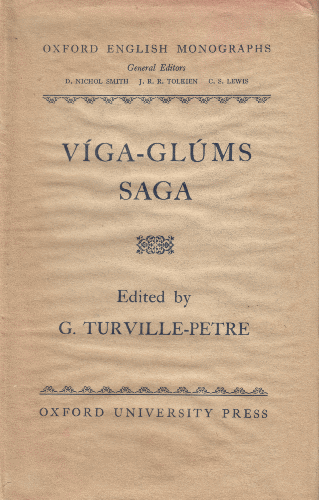
This is volume one in the Oxford English Monographs series. Tolkien was one of the General Editors for the series.
'The Lay of Skírnir
The Skirnismol is found complete in the Codex Regius, and through stanza 27 in the Arnamagnæan Codex. Snorri quotes the concluding stanza. In Regius the poem is entitled "For Scirnis" ("Skirnir's journey").
The Skirnismol differs sharply from the poems preceding it, in that it has a distinctly ballad quality. As a matter of fact, however, its verse is altogether dialogue, the narrative being supplied in the prose "links," concerning which cf. introductory note to the Grimnismol. The dramatic effectiveness and vivid characterization of the poem seem to connect it with the Thrymskvitha, and the two may possibly have been put into their present form by the same man. Bugge's guess that the Skirnismol was the work of the author of the Lokasenna is also possible, though it has less to support it.
Critics have generally agreed in dating the poem as we now have it as early as the first half of the tenth century; Finnur Jonsson puts it as early as goo, and claims it, as usual, for Nor way. Doubtless it was current in Norway, in one form or another, before the first Icelandic settlements, but his argument that the thistle (stanza 31) is not an Icelandic plant has little weight, for such curse-formulas must have traveled freely from place to place. In view of the evidence pointing to a western origin for many or all of the Eddic poems, Jonsson's reiterated "Digtet er sikkert norsk og ikke islandsk" is somewhat exasperating. Wherever the Skirnismol was composed, it has been preserved in exceptionally good condition, and seems to be practically devoid of interpolations or lacunæ.
Óðinn
[ˈoːðinː]
ᚢᚦᛁᚾ
Lord of the Hanged
Credits
Please let us know if u have not been credited. We are gratefull to all people bringing this wonderful subject back to us.
References:
The writings of Dr. Jackson Crawford and Daniel Mc Coy are a neverending inspiration and most favoured of sources.Kershaw, The One-eyed God; Régis Boyer, “Óðinn d’après Saxo Grammaticus et les sources norroises: étude comparative,” Beiträge zur nordischen Philologie 15 (1986): 143– 57; Peter Buchholz, “Odin: Celtic and Siberian Affinities of a Germanic Deity,” Mankind Quarterly 24:4 (1984): 427–37; Lotte Motz, “Óðinn’s Vision,” Maal og Minne 1 (1998): 11– 19; Clive Tolley, “Sources for Snorri’s Depiction of Óðinn in Ynglinga Saga: Lappish Shamanism and the Historia Norvegiae,” Maal og Minne 1 (1996): 67–79
Emma Groeneveld
notes to 1-5 source voluspa.org
[Prose. Freyr: concerning his father, Njorth, and the race of the Wanes in general, cf. Voluspo, 21 and note. Snorri thus describes Njorth's family: "Njorth begat two children in Noatun; the son was named Freyr, and the daughter Freyja; they were fair of aspect and mighty. Freyr is the noblest of the gods; he rules over rain and sunshine, and therewith the fruitfulness of the earth; it is well to call upon him for plenty and welfare, for he rules over wealth for mankind. Freyja is the noblest of the goddesses. When she rides to the fight, she has one-half of the slain, and Othin has half. When she goes on a journey, she drives her two cats, and sits in a cart. Love-songs please her well, and it is good to call on her in love-matters." Hlithskjolf: Othin's watch-tower; cf. Grimnismol, introductory prose. He said: both manuscripts have "Then Skathi said:" (Skathi was Njorth's wife), but Bugge's emendation, based on Snorri's version, is doubtless correct. 1. My son: both manuscripts, and many editors, have "our son," which, of course, goes with the introduction of Skathi in the prose. As the stanza is clearly addressed to Skirnir, the change of pronouns seems justified. The same confusion occurs in stanza 2, where Skirnir in the manuscripts is made to speak of Freyr as {footnote p. 108}"your son" (plural). The plural pronoun in the original involves a metrical error, which is corrected by the emendation. 4. Elfbeam: the sun, so called because its rays were fatal to elves and dwarfs; cf. Alvissmol, 35.]
notes to 6-10 source voluspa.org
[6. Gymir: a mountain-giant, husband of Aurbotha, and father of Gerth, fairest among women. This is all Snorri tells of him in his paraphrase of the story. 7. Snorri's paraphrase of the poem is sufficiently close so that his addition of another sentence to Freyr's speech makes it probable {footnote p. 110} that a stanza has dropped out between 7 and 8. This has been tentatively reconstructed, thus: "Hither to me shalt thou bring the maid, / And home shalt thou lead her here, / If her father wills it or wills it not, / And good reward shalt thou get." Finn Magnusen detected the probable omission of a stanza here as early as 1821. 8. The sword: Freyr's gift of his sword to Skirnir eventually proves fatal, for at the last battle, when Freyr is attacked by Beli, whom he kills bare-handed, and later when the fire-demon, Surt, slays him in turn, he is weaponless; cf. Voluspo, 53 and note. Against the giants grim: the condition of this line makes it seem like an error in copying, and it is possible that it should be identical with the fourth line of the next stanza. 10. Some editors reject line 3 as spurious.]
notes to 11-15 source voluspa.org
[12. Line 2 is in neither manuscript, and no gap is indicated. I have followed Grundtvig's conjectural emendation. 13. This stanza is almost exactly like many in the first part of the Hovamol, and may well have been a separate proverb. After this stanza the scene shifts to the interior of the house. 15. No gap indicated in either manuscript. Bugge and Niedner have attempted emendations, while Hildebrand suggests that the last two lines of stanza 14 are spurious, 14, 12, and 15 thus forming a single stanza, which seems doubtful.]
notes to 16-20 source voluspa.org
[16. Brother's slayer: perhaps the brother is Beli, slain by Freyr; the only other references are in Voluspo, 53, and in Snorri's paraphrase of the Skirnismol, which merely says that Freyr's gift of his sword to Skirnir "was the reason why he was weaponless when he met Beli, and he killed him bare-handed." Skirnir himself seems never to have killed anybody. 17. Wise Wanes: Cf. Voluspo, 21 and note. 18. The Arnamagnæan Codex omits this stanza. 19. Apples: the apple was the symbol of fruitfulness, and also of eternal youth. According to Snorri, the goddess Ithun had charge of the apples
notes to 21-25 source voluspa.org
[21. Ring: the ring Draupnir ("Dropper") was made by the dwarfs for Othin, who laid it on Baldr's pyre when the latter's corpse was burned (Cf. Voluspo, 32 and note, and Baldrs Draumar). Baldr, however, sent the ring back to Othin from hell. How Freyr obtained it is nowhere stated. Andvari's ring (Andvaranaut) had a similar power of creating gold; cf. Reginsmol, prose {footnote p. 115} after stanza 4 and note. Lines 3 and 4 of this stanza, and the first two of stanza 22, are missing in the Arnamagnæan Codex. 25. The first two lines are abbreviated in both manuscripts.]
notes to 26-30 source voluspa.org
[26. With this stanza, bribes and threats having failed, Skirnir begins a curse which, by the power of his magic staff, is to fall on Gerth if she refuses Freyr. 27. Eagle's hill: the hill at the end of heaven, and consequently overlooking hell, where the giant Hræsvelg sits "in an eagle's guise," and makes the winds with his wings; cf. Vafthruthnismol, 37, also Voluspo, 50. The second line is faulty in both manuscripts; Hildebrand's emendation corrects the error, but omits an effective touch; the manuscript line may be rendered "And look and hanker for hell." The Arnamagnæan Codex breaks off with the fourth line of this stanza. 28. Hrimnir: a frost-giant, mentioned elsewhere only in Hyndluljoth, 33. Line 3 is probably spurious. Watchman of the gods: Heimdall; cf. Voluspo, 46. 29. Three nouns of doubtful meaning, which I have rendered rage, longing, and heart respectively, make the precise force of this stanza obscure. Niedner and Sijmons mark the entire stanza as interpolated, and Jonsson rejects line 5. 30. In Regius and in nearly all the editions the first two lines of this stanza are followed by lines 3-5 of stanza 35. I have followed Niedner, Sijmons, and Gering. The two words here translated vile things are obscure; Gering renders the phrase simply "Kobolde."]
notes to 31-35 source voluspa.org
[31. The confusion noted as to the preceding stanza, and a metrical error in the third line, have led to various rearrangements and emendations; line 3 certainly looks like an interpolation. Three-headed giants: concerning giants with numerous heads, cf. Vafthruthnismol, 33, and Hymiskvitha, 8. 32. No gap indicated in the manuscript; Niedner makes the line here given as 4 the first half of line 3, and fills out the stanza thus: "with which I will tame you, / Maid, to work my will." The whole stanza seems to be either interpolated or out of place; it would fit better after stanza 25. 33. Jonsson marks this stanza as interpolated. The word translated most evil is another case of guesswork. 34. Most editors reject line 3 as spurious, and some also reject line 6. Lines 2 and 3 may have been expanded out of a single line running approximately "Ye gods and Suttung's sons." Suttung: concerning this giant cf. Hovamol, 104 and note. 35. Most editors combine lines 1-2 with stanza 36 (either with the first two lines thereof or the whole stanza), as lines 3-5 stand in the manuscript after line 2 of stanza 30. Hrimgrimnir ("The Frost-Shrouded"): a giant not elsewhere mentioned. Line 5, as a repetition of line 4, is probably a later addition.]
notes to 36-40 source voluspa.org
[36. For the combination of this stanza with the preceding one, cf. note on stanza 35. The scribe clearly did not consider that the stanza began with line I, as the first word thereof in the manuscript does not begin with a capital letter and has no period before it. The first word of line 3, however, is so marked. Line 5 may well be spurious. 37. Again the scribe seems to have been uncertain as to the stanza divisions. This time the first line is preceded by a period, but begins with a small letter. Many editors have made line 2 {footnote p. 119} into two half-lines. A charm: literally, the rune Thurs (b); the runic letters all had magic attributes; cf. Sigrdrifumol, 6-7 and notes. 40. Barri: "The Leafy."]
notes to 41-42 source voluspa.org
[42. Abbreviated to initial letters in the manuscript. 43. The superscription is lacking in Regius. Snorri quotes this one stanza in his prose paraphrase, Gylfaginning, chapter 37 The two versions are substantially the same, except that Snorri makes the first line read, "Long is one night, long is the second."]

