Ragnarök
The faithed Götterdämmerung
The Story.
Ginnungagap
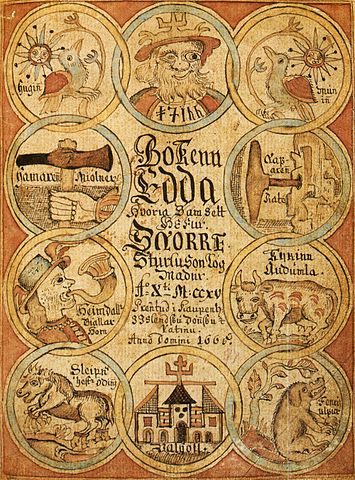
In the Prose Edda, Snorri Sturlusson gives a complete description of creation that combines a number of older sources, which are not always consistent with each other. The major Eddic poems used by Snorri are the Vafþrúðnismál and Grímnismál (the lays of Vafþrúðnir and Grímnir), which more or less duplicate each other, and the Voluspá (Prophecy of the Seeress); but he also derives some details from sources lost to us and adds some deductions of his own. Quoting the Voluspá (st. 3), Snorri stresses that at the beginning of time there was nothing but a great void called Ginnungagap, a void filled with powerful magic forces (the term ginnung is related to Old Norse ginnregin, "the supreme gods", and runic ginArunAR, "runes endowed with magic power"). In the Voluspá, the text reads: "When Ymir lived, in earliest times, there was neither sand, nor sea, nor chill waves", whereas Snorri says, "In the beginning not anything existed, there was no sand, nor sea, nor cooling waves.".
Mixed Sources
It is probable that Snorri's version reflects the older tradition, because the idea of an empty space and a world of mere potentiality preceding creation seems to belong to the ancestral heritage of the Germanic people since it finds an uncanny parallel in the well-known cosmogonic hymn of the Rgveda: "There was neither nonbeing nor being; nor was there space nor the sky above"(10.129). The same idea is expressed in Old Norse by the phrase "Jorð fannz æva né upphiminn" ("Earth was unknown and heaven above"), an old poetic image paralleled in Old High German in the ninth-century Prayer of Wessobrunn: "Dat ero ni was noh ufhimil" ("There was neither earth nor sky above"), as well as in the Old English formula "Eorðan ... and upheofon." Long before the earth was formed there existed Niflheimr, the dark misty world of death. In Niflheimr was a well called Hvergelmir (lit., "resounding kettle", from hverr, "kettle", and -gelmir, related to galmr, "roaring"), from which eleven rivers flowed. In the south lay the blazing hot world of Múspell over which the giant Surtr ("black") held sway. The occurence of the Old High German word múspilli in a tenth-century Bavarian eschatological poem, where it designates the universal fire at the end of the world, indicates that the concept reflects an old Germanic tradition. The rivers whipped by showers pouring out of Niflheimr froze and layer after layer of ice piled up in Ginnungagap. However, sparks and glowing embers flying out of Múspell met the hoarfrost and the ice, and from the slush and heat life emerged in the shape of an anthropomorphic primeval being who received the name og Ymir, or Aurgelmir. From this primal giant sprang the dreadful brood of the frost giants, whom he engendered by sweating a male and a female from under his left arm and begetting a son from one of his legs with the other.
Merging traditions
Obviously, Snorri has merged two traditions here that the Vafþrúðnismál keeps separate: in stanza 21, Ymir is named as the giant involved in the formation of the world, but in stanzas 29-35, Vafþrúðnir, the oldes living giant, explains to Óðinn that the genealogy of the giants begins with Aurgelmir, who fathered Þruðgelmir, who fathered Bergelmir, who fathered Vafþrúðnir himself. No direct source is available for the account of the origin of the gods that Snorri gives us next in the Gylfaginning; the melting rime has taken the shape of a cow, Auðhumla, whose name contains Old Norse auðr ("riches"), and another term connected with the English dialect word hummel or humble ("hornless cow"), presumably designating a "rich hornless cow". This cow feeds Ymir with the milk flowing from her udders, a tradition paralleling that of the primeval cow in Indo-Iranian mythology. Auðhumla gets her own food by licking the salty ice blocks, but in doing so, she gives shape to another primal being, Búri, who begets a son, Borr. Borr marries Bestla, the daughter of the giant Bolþorn (literally, "evil thorn", a term still used in the Jutland dialect (bøltorn) to designate a "scrappy, violent person"). Borr and his wife have three sons: Óðinn, Vili, and Vé. When the three divine brothers kill the giant Ymir, the flow of blood gushing from his wounds drowns all the frost giants (hrímþursar), except Bergelmir, who escapes mysteriously with his family to continue the race. Now the gods set about building the earth. The body of Ymir is carried into the middle of the great void; his blood forms the sea and the lakes, his flesh the earth, and his skull the sky (with a dwarf at each corner, as if to uphold it), his hair the trees, his brain the clouds, his bones the mountains, and so on. Sparks from Múspell forms the stars and heavenly bodies, and the gods order their movements, determining the divisions of time. The earth was circular, surrounded by a vast ocean. In the middle of the earth the gods established Miðgarðr, a residence for mankind, strengthened by a fence made from the eyebrows of Ymir, and they gave land on the shore for the giants to settle down. The next task of the gods was the creation of man, which is related in the myth of Askr and Embla (Voluspá 17-18). Finally, they built Ásgarðr, their own residence.
Cosmogony
Origin of the cosmos
Before there was soil, or sky, or any green thing, there was only the gaping abyss of Ginnungagap. This chaos of perfect silence and darkness lay between the homeland of elemental fire, Muspelheim, and the homeland of elemental ice, Niflheim.
Frost from Niflheim and billowing flames from Muspelheim crept toward each other until they met in Ginnungagap. Amid the hissing and sputtering, the fire melted the ice, and the drops formed themselves into Ymir (“Screamer”), the first of the godlike but destructive giants. Ymir was a hermaphrodite and could reproduce asexually; when he slept, more giants leapt forth from his legs and from the sweat of his armpits.
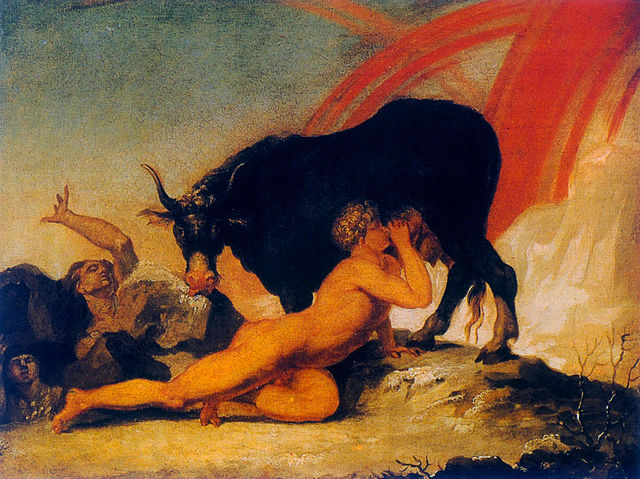
As the frost continued to melt, a cow, Audhumla (“Abundance of Humming”[2]), emerged from it. She nourished Ymir with her milk, and she, in turn, was nourished by salt-licks in the ice. Her licks slowly uncovered Buri (“Progenitor”[3]), the first of the Aesir tribe of gods. Buri had a son named Bor (“Son”[4]), who married Bestla (perhaps “Wife”[5]), the daughter of the giant Bolthorn (“Baleful Thorn”[6]). The half-god, half-giant children of Bor and Bestla were Odin, who became the chief of the Aesir gods, and his two brothers, Vili and Ve.
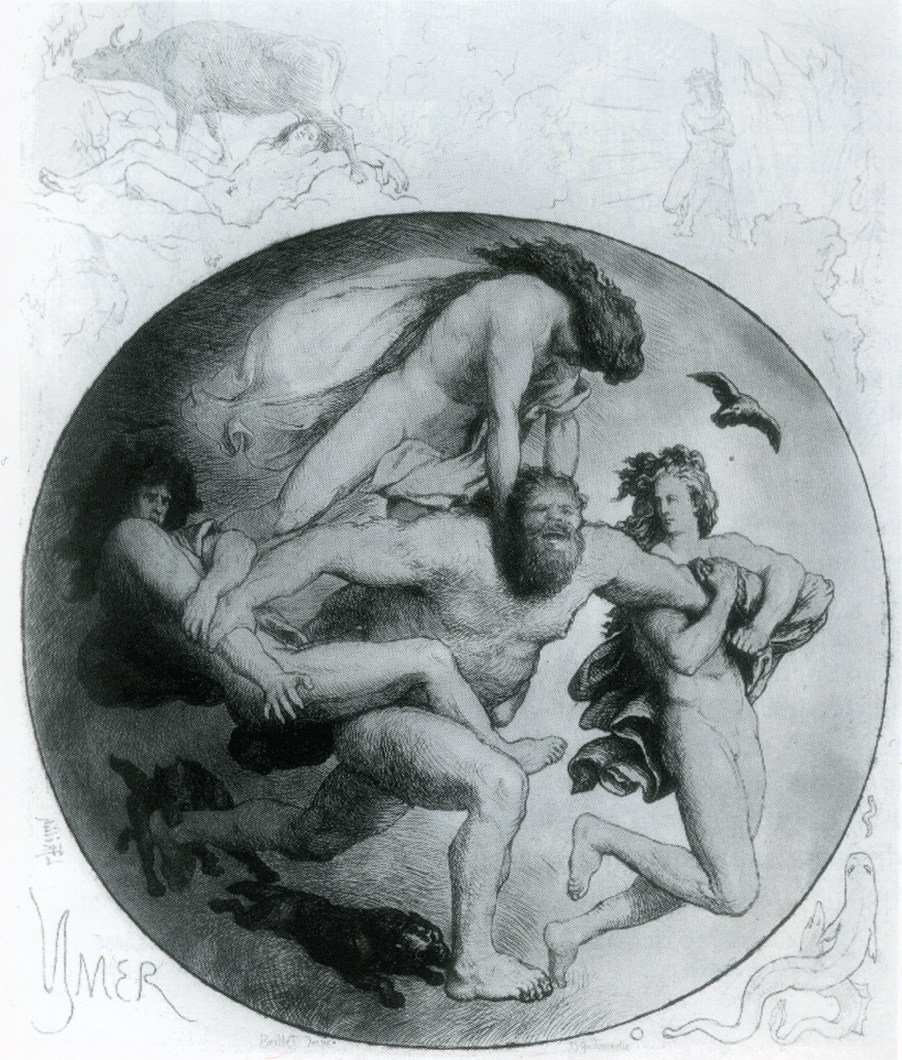
Odin and his brothers slew Ymir and set about constructing the world from his corpse. They fashioned the oceans from his blood, the soil from his skin and muscles, vegetation from his hair, clouds from his brains, and the sky from his skull. Four dwarves, corresponding to the four cardinal points, held Ymir’s skull aloft above the earth.
The gods eventually formed the first man and woman, Ask and Embla, from two tree trunks, and built a fence around their dwelling-place, Midgard, to protect them from the giants.[7][8][9][10]
Order from Chaos
Thematically, Ymir (Aurgelmir) is the personification of the chaos before creation, which is also depicted as the impersonal void of Ginnungagap. Both Ymir and Ginnungagap are ways of talking about limitless potential that isn’t actualized, that hasn’t yet become the particular things that we find in the world around us. This is why the Vikings described it as a void (as have countless other peoples; consider the “darkness upon the face of the deep” of the first chapter of Genesis, for example). It is no-thing-ness. But it nevertheless contains the basic stuff out of which the gods can make true things – in this case, the primal matter is Ymir’s body, which the gods tear apart to craft the elements.
Merging traditions
Obviously, Snorri has merged two traditions here that the Vafþrúðnismál keeps separate: in stanza 21, Ymir is named as the giant involved in the formation of the world, but in stanzas 29-35, Vafþrúðnir, the oldes living giant, explains to Óðinn that the genealogy of the giants begins with Aurgelmir, who fathered Þruðgelmir, who fathered Bergelmir, who fathered Vafþrúðnir himself. No direct source is available for the account of the origin of the gods that Snorri gives us next in the Gylfaginning; the melting rime has taken the shape of a cow, Auðhumla, whose name contains Old Norse auðr ("riches"), and another term connected with the English dialect word hummel or humble ("hornless cow"), presumably designating a "rich hornless cow". This cow feeds Ymir with the milk flowing from her udders, a tradition paralleling that of the primeval cow in Indo-Iranian mythology. Auðhumla gets her own food by licking the salty ice blocks, but in doing so, she gives shape to another primal being, Búri, who begets a son, Borr. Borr marries Bestla, the daughter of the giant Bolþorn (literally, "evil thorn", a term still used in the Jutland dialect (bøltorn) to designate a "scrappy, violent person"). Borr and his wife have three sons: Óðinn, Vili, and Vé. When the three divine brothers kill the giant Ymir, the flow of blood gushing from his wounds drowns all the frost giants (hrímþursar), except Bergelmir, who escapes mysteriously with his family to continue the race. Now the gods set about building the earth. The body of Ymir is carried into the middle of the great void; his blood forms the sea and the lakes, his flesh the earth, and his skull the sky (with a dwarf at each corner, as if to uphold it), his hair the trees, his brain the clouds, his bones the mountains, and so on. Sparks from Múspell forms the stars and heavenly bodies, and the gods order their movements, determining the divisions of time. The earth was circular, surrounded by a vast ocean. In the middle of the earth the gods established Miðgarðr, a residence for mankind, strengthened by a fence made from the eyebrows of Ymir, and they gave land on the shore for the giants to settle down. The next task of the gods was the creation of man, which is related in the myth of Askr and Embla (Voluspá 17-18). Finally, they built Ásgarðr, their own residence.