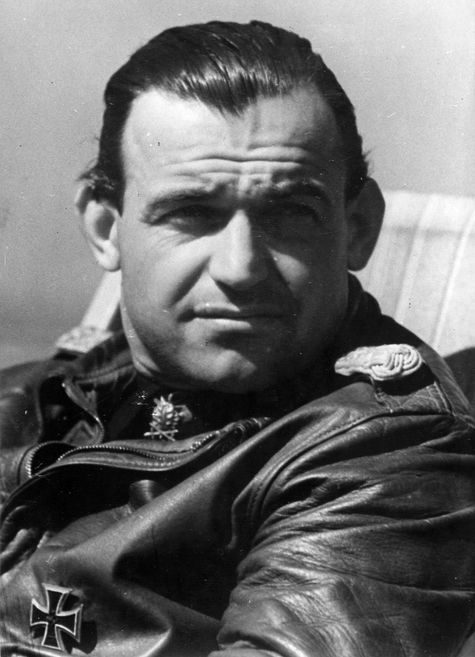
Oberstleutnant Heinrich "Pritzl" Bär is considered by many to be the Luftwaffe's Greatest
Ace of WWII.
Bär was a fighter pilot in the Luftwaffe at the start of the War and flew over 1,000
missions
between September 1, 1939 and May 8, 1945.
He flew on all fronts and against every type of allied
aircraft
and by war's end had amassed at least 220 victories. He was second only to Hans-Joachim Marseille in
shooting
down Brits and Yanks with 124 victories in the West. Bär also shot down 21 four engine bombers and
in 1945 scored 16 victories while flying the Me 262 Jet Fighter, making him the top scoring Day pilot in that
type. This kind of achievement would normally have earned him the coveted Knight's Cross of the Iron Cross
with Oak Leaves, Swords and Diamonds, or in German, Ritterkreuz des Eisernen Kreuzes mit Eichenlaub,
Schwertern und Brillanten... Hermann Göring's personal dislike of Bär, coupled with Bär's insubordinate
character and lack of military discipline, deprived him of this award. Three times Heinz Bär was
recommended
for the Knight's Cross of the Iron Cross with Oak Leaves, Swords and Diamonds. All three commendations were
denied by Reichsmarschall Hermann Göring. Bär shot down a further 130 enemy aircraft after he had received
the Swords. During the course of the war he was shot down 18 times with 14 forced landings and four parachute
jumps.
Heinz was born on May 25, 1913 in Sommerfeld near Leipzig. His father was a farmer and Heinz grew up with a
love
of the outdoors. In the 1920's he became interested in flight and learned to fly gliders graduating to
powered
aircraft which he first flew in 1930.
He joined the Luftwaffe in 1937 in order to build hours and then become an airline pilot. At the start of
WWII
Bär was a Unteroffizer flying Me 109's with 1./JG 51.
Stationed on the border with France, Bär achieved his first victory—a Curtiss P-36 Hawk—on
25
September 1939 during the Phoney War air skirmishes with the Armée de l'Air (French air force),
earning
him the Iron Cross 2nd Class on 27 September 1939.
Victories Achieved:
* 4 Battle of France
* 13 Battle of Britain
* 96 Eastern Front
* 65 North Africa / Mediterranean Front
* 42 Western Front / Reichsverteidigung (Defense of the Reich)
16 of these while flying the Me 262 jet fighter.
Also among these 42 Western Front aerial victories are 21 US heavy bombers and one Mosquito.
During the period between his 3rd and 4th claim ,between 23.5.40-20.8.40, he had several emergency landings
in badly damaged aircraft and was shot down over the English Channel on 2 September 1940 by a Spitfire.
On September 2 1940, after claiming a Spitfire shotdown, he was nursing his damaged Me 109 back to France
when a Spitfire finished him off. He bailed out into the English Channel and after swimming for two hours
reached a buoy which he clung to until picked up by a German patrol boat later that evening.
On the morning of the 22 June 1941, Bär and his wingman Oberfeldwebel Heinrich Höfemeier were escorting a
damaged Heinkel He 111 over German lines when they made contact with 18 Tupolev SB bombers from the 39 SBAP
and 10 SAD. The German pilots attacked; Höfemeier claimed four, Bär two—though the former was wounded in the
arm.
In early 1941, he was credited with an additional four aerial victories against the Royal Air Force (RAF),
bringing his total to 17
In June 1941, JG 51 was transferred Eastern Front to take part in Operation Barbarossa with 1 Staffel. Its
task was to support Panzer Group 2, which formed the right flank of Army Group Centre, advancing north
east(bf109-f4)
towards Moscow
25 Sept 1939
Stationed on the border with France, Bär achieved his first victory—a Curtiss P-36 Hawk—on 25
September
1939 during the Phoney War air skirmishes with the Armée de l'Air (French air force), earning him
the
Iron Cross 2nd Class on 27 September 1939.
1230 Curtiss Hawk Weissenburg/Lauterburg Probably No. 112 of GC 4/4. Capt. P Claude baled out
but
shot at in parachute, DOW (also claimed by Pitcairn)
21 May 1940
1620 Hurricane (D-520?) Samer Not likely to have been a Spitfire or a Hurricane, no attributable
losses
found
23 May 1940
1110 Hurricane Dunkirk or Bethune Serial unknown of 253 sqn. P/O J D Ford believed POW
20 Aug 1940
1610 Spitfire I Overclaiming, only 1 attributable loss: R6818 of 65 sqn. P/O K G Hart, baled out
and
rescued from sea (versus 4 claims in total)
24 Aug 1940
1413 Hurricane I L1659 of 501 sqn? Sgt. William J Green crashlanded at Hawkinge after combat over
Manston, unhurt (attributed to friendly Flak, two other claims at this time)
29 Aug 1940
2010 Spitfire Judging by timings alone, were these actually the two 501 sqn Hurricanes lost at
1920-1930
BT? R4223 of Sgt. William J Green baled out, rescued safely plus P3102 of F/L John Albert Axel
Gibson
(NZ) baled out slightly WIA (Joppien also claimed at this time, as did Rolf Pingel of I./JG 26)
2 Sept 1940
0915 Spitfire Unit definitely in action against 54 sqn at this time. Overclaiming, no apparent
losses.
Or possibly 603 sqn: X4250/XT-X of Sgt. Jack Stokoe damaged (Terry and Fleig also claimed)
8 Nov 1940
1218 Hurricane Was this N2649 of 605 sqn? P/O P Tarkowski safe, cat.3 damaged over
Maidstone-Staplehurst,
also possibly V6870 of 257 "Burma" sqn, Sgt. A D Page KIA over Maidstone or V7652 of 615 sqn, P/O L
N
Landels WIA over Cranbrook
8 Nov 1940
1505 Hurricane N of Dungeness @ 5000m Possibly V6805 of 501 sqn, Sgt. Harry Cyril Grove KIA. Lost
near
Blackheath/Sevenoaks around this time.
16 Apr 1940
1505 Hurricane N of Dungeness @ 5000m Possibly V6805 of 501 sqn, Sgt. Harry Cyril Grove KIA. Lost
near
Blackheath/Sevenoaks around this time.
21 Apr 1940
2007 Hurricane IIA NW of Ashford @ 6500m 1 sqn. Overclaiming, only one aircraft damaged. F/L
Velebnovsky
safe (also claimed by Joppien)
6 may 1940
1410 Spitfire II 15-20km NW of Calais @ 200m 74 sqn, 3 losses and one damaged. P8364 or P7928 of
P/O J
Howard, KIA. P7537 of Sgt. A D Arnett, POW. P7428 of Sgt. A F Wilson baled out safely as the engine
caught fire. P/O R G E Boulding, cat. 2 damage, safe (versus 5 claims)
11 May 2041
2140 Spitfire (actually a Hurricane II?) 8km E of Deal @ 50m Day's only known loss and definitely a
victim of JG 2 was Hurricane II V7175 of 504 sqn. F/L B E G White WIA
22 june 1941
0725 MiG ("I-18") near Starnice 41 IAP, 124 IAP, 126 IAP or 129 IAP, 9 SAD. 126 IAP lost pilots G Alaev,
Panfilov and V Ushakov
22 June 1941
Bär had achieved his 19th and 20th victories on 22 June 1941 with a pair of Russian SB-2s, during a
melee of the 39th SBAP.1130 and 1133 2 x SB-2s near Terespol VVS Western Front. SB losses
include 130 SBAP, crew of Boris Vladimirovich Bastanzhiev (likely JG 51
victim, already damaged by Flak), they also lost crews of Mikhail Pavlovich Bugorkov and Pavel Borisovich
Shakhmatov
30 June 1941
055, 1112, 1920, 1935 and 1940 5 x DB-3s Bobruisk/Histowka sector VVS Western Front.
96 DBAP definitely lost one near Bobruisk, navigator was Lt. Alexey Alekseevich Egorov and gunner was
Aleksey Vasilyevich Shiroborkin. 98 DBAP lost St.Lt. Ivan Mikhailovich Trejbsho (AE CO)
The next day, he claims an I-16 destroyed.
1 July 1941
1345 I-16 "Rata" near Nowo Histowka said to be from 161 IAP by at least one published source. Was it
actually Ml.Lt. Vladimir Ivanovich Borisov of 163 IAP KIA?
Within two weeks of combat against the Soviet Air Force, Bär's tally rose to 27, which earned him the Knight's
Cross of the Iron Cross (Ritterkreuz des Eisernen Kreuzes) on 2 July 1941.
3 July 1941
1345 ("V-11") Bobruisk sector Likely 4 ShAP IL-2 Sturmoviks. Possible losses to fighters include Starshiy
Politruk Dryukov and Jnr Lts Krivich and Alekseykin (versus at least 9 claims)
21 May 1940
1344 and 1345 2 x DB-3s Bobruisk sector Day's DB-3 losses include at least one from 96 DBAP. Gunner was
Serzhant Nikolay Alekseevich Borzenko KIA, navigator Ivan Semenovich Frolov also KIA as was Ml.Lt. Fedor
Sergeevich Shipiko (all from the same crew?) another gunner KIA was Alexander Ivanovich Burenkov (Orsha
sector)
11 July 1941
1502, 1505 and 1645. 3 x DB-3s Bobruisk sector Were these claimed against 96 DBAP, 42 DBAD? They suffered
gunner Nikita Maksimovich Balabanov WIA by fighters this date and St.Lt. Demiyan Stepanovich Borodavka
(AE CO) KIA. 207 DBAP lost several crews as well: those of Lt. Ivan Fedorovich Zverev, St.Lt. Vasily
Vasilievich Zybnev, Ml.Lt. Boris Sergeevich Zhekov, Ml.Lt. Ivan N. Pohodeev, Ml.Lt. Alexander Vasilyevich
Suhovskij. Another gunner from 96 DBAP was Viktor Petrovich Sakharov KIA
On 23 July 1941, Heinz shoots down another trio of bombers; this time Pe-2s.
23 July 1941
1257, 1302 and 1310 3 x Pe-2s raids on Shatalowo airfield/Dankowow
411 BAP/OSNAZ. Overclaiming, only 3 losses in this engagement (versus 5 claims all up)
He finally gets his promotion to Oberleutnant on 1 August 1941.
3 Aug 1941
1355 Pe-2? (Claimed as an “R-3”) Could this have been from 136 BAP? Ml.Lt. Stepan Ivanovich Astapov KIA
this date. A definite loss to fighters was 33 BAP, Alexey Maksimovich Burkov KIA in Guta sector
9 Aug 1941
On 9 August an SB bomber was claimed from a formation of eight belonging to the 21 DBAP and 57 BAP's 3rd
Eskadrilya—five Soviet aircraft were shot down.
9 Aug 1941
1900 SB-3 3 AE, 57 BAP. 5 losses (two over the target, 3 forcelanded at separate bases) (Versus 5 claims
so this one is indeed a legitimate victory)
10 Aug 1941
1055 I-15 Was this Lt. Anatoli Danilovich Yaremchuk of 127 IAP KIA this date?
On 14 August, he was awarded the Knight's Cross of the Iron Cross with Oak Leaves (Ritterkreuz des Eisernen
Kreuzes mit Eichenlaub) for 60 victories.
28 Aug 1941
1812 and 1815 2 x Pe-2s SE of Nowgorod 261 BAP. Crews of Kapitan Yuriy Mykolayovych Garbko (AE CO,
returned later with some of his crew), Lt. Alexander Ilyich Lyagushin and Lt. Nikolai Stepanovich
Bocharov all shot down (third claim was made by Karl-Gottfried Nordmann so these are again legitimate
victories)
On 30 August 1941, he became an "Ace-in-a-Day" by shooting down SIX Soviet aircraft, for his 44th-49th
victories.
On this day JG 51 was credited with 113 aerial victories in total, among them their 1,000th aerial
victory—the first unit to reach this figure—and Oberst Werner Mölders, with 82 aerial
victories, surpassed Manfred von Richthofen in number of victories.
The next day, 31 August 1941, he was shot down behind enemy lines by an Ilyushin Il-2 after claiming 2
shot down Pe-2s, some 50 kilometers (31 mi) behind Soviet lines, near Novgorod-Seversky, and was forced to
bail out in high winds.
31 Aug 1941
1120 and 1125 2 x Pe-2s Likely 261 BAP. Crews of Lt. Petr Ivanovich Bormatin and Nikolay Grigoryevich
Shirokii all KIA
21 DBAP. Crews of St.Lt. Mikhail Alekseevich Egurnov and Ml.Lt. Mikhail Ivanovich Nistratov all KIA
The situation: Michael Barrentine has shared some material with me that shows III./JG 53's 4 x DB-3
victory claims on the afternoon of 31.8.41 were in reality SBs from 150 SBAP. There were 3 losses and
they came from the Eskadrilya of Kapitan V. S. Lyapin
Previously I had taken them to be genuine DB-3 of 21 DBAP because that regiment lost 2 x DB-3s,
definitely attributed to fighters on that date. With the III./JG 53 claims ruled out by being matched to
the 150 SBAP losses, who then shot down the DB-3s from 21 DBAP....?
Best candidate now appears to be Heinz Baer around midday, his 50th and 51st (74th and 75th) claims.
Friebel claimed one in the same engagement and the only other claims for DB-3s were by Seelmann, but the
two claims are hours apart so I doubt they came from the same Regiment.
So yeah, best candidate remains Baer and Friebel. Slight overclaim: 2 losses for 3 claims.
He was punished on landing and then was dragged on the ground for a football field or two before he managed
to collapse his parachute. Though he had fractured his spine, he evaded capture for two days before making
back to German lines. His injuries were so severe that he required an extended stay in hospital.
Bär evaded Soviet patrols which rushed to the crash site. Bär remained in hiding through to
the following night. He turned his leather jacket inside-out and discarded his flying boots to present
himself as a Russian peasant.
Vanity prevented him from throwing away the Knight's Cross and Oak Leaves and he hid the items. Bär
eventually made it to German lines but aggravated his injuries and spent two months in hospital.
After recovering, he returned to JG 51.
Bär was promoted to Hauptmann in late 1941 and appointed Squadron Leader of 12./JG 51 in early 1942
2 Dec 1941
1015 Pe-2 Day's recce losses to fighters include 366 RAP, crew of pilot Pepelevim KIA and navigator
Farvaz Husainov WIA. 2 APDR lost crew of Lt. Fiodor Antonovich Koshelev failed to return
2 Dec 1941
Baer claimed 3 x MiGs throughout the day. Day’s losses include Lt. Alexander Petrovich Bogdanov of 177
IAP KIA
7 Dec 1941
1130 and 1357 2 x Pe-2s One of these was likely 46 BAP. Crew of Lt. Alexey Yemelyanovich Khatuntsev, Lt.
Ahtem Abdarman Adji-Khalil and Serzhant Aleksandr Sivkov all KIA
By the end of 1941, after Mölders (115), Lützow (100), Galland (96) and Gollob (85), Bär's 80 victory credits
placed him among the leading pilots of the War.
From January 1942 he was appointed Gruppenkommandeur (Group Commander) of IV Gruppe JG51.
By February 1942, he had 90 victories and had been awarded the Swords to his Knight's Cross.
On 11 May, Bär was transferred from IV./JG 51 on the Moscow front to take command of I. Gruppe of Gordon
Gollob's Jagdgeschwader 77 (JG 77) . Bär replaced Herbert Ihlefeld who had been transferred.
JG 77 was tasked with supporting the hard fighting in the Crimean Campaign over the Kerch Strait on the Crimean
Peninsula.
Led by the flying aces Gollob and Bär, JG 77 took over the air space above Kerch-Taman.
11 May 1942
Gollob and Bär shot down two and three LaGG-3s respectively, raising Bär's victory total to 93.
19 May 1942
Bär claimed five further aerial victories—including a Polikarpov R-5 in the morning for his 100th victory
and four more I-16s in one afternoon mission: his victory total now stood at 103.
0942 R-5 According to allaces.ru, TsAMO 709 NBAP tells us Gersh Nikolaevich Bibikov was listed as killed
in a crash this date. Was it due to enemy action and therefore possibly Baer’s victory?
He was the 9th Luftwaffe pilot to achieve the century mark.
In June 1942, JG 77 was moved to the Mediterranean theater and took part in the air battles over Malta before
relocating to Tunisia and participating in the North African Campaign.
11 Oct 1942
Spitfire R183 lost off Malta this date, EP550 damaged and crashlanded Luqa
13 Oct 1942
three Spitfire fighters from 185 and 1345 Squadron near the Sicilian coast.
0758 and 0814 2 x Spitfires 185 sqn. They lost Mk VB Trop EP316 this date
14 Oct 1942
1759 Spitfire Day's losses include AR470 of 1435 sqn and AR489 of 126 sqn off Kalafrana. AR471 was
damaged by Bf109s this date. Other losses were EN979 of unit not specified, EP203 of 1435 sqn (versus
nine claims)
17 Oct 1942
1332 Spitfire Day's losses include EP341 and EP521, damaged by Bf109 and crashed on approach to Hal Far.
EP955 of 229 sqn lost this day as well
I./JG 77 soon transferred to North Africa and took part in the Tunisian Campaign. With the war heating up in
the Mediterranean, Bär was transferred to Sicily and given command of JG 77 where he racked up 45 more
victories before being assigned back to Germany to help battle the American heavy bomber threat.
3 Nov 1942
208 and 1210 2x Hurricanes?(Claimed as "Spitfires") SW of El Alamein
80 and 127 sqns. 80 sqn lost BP337/B, F/L R G Foskett returned; 127 sqn lost BN406 of F/L R C Lawrence
KIA, BP292 of Sgt. R R Mayze MIA, BP289 of Sgt. D G Andrews baled out WIA-POW (arm shot off),
3 Nov 1942
HM130 of
P/O A D Melville KIA, HL629 of P/O A R Rebman KIA, HL773 of Sgt. N G Thomas forcelanded in a minefield;
BG904 of F/S B Wilshaw safe & HM140 of Sgt. A R Moulden safe
5 Nov 1942
1340 and 1350 Curtiss P-40 and Spitfire Day's losses include P/O Wilson of 80 sqn. 145 sqn lost F/S
Frederick Arthur Stillman. 274 sqn had W/O Neil bale out into sea after being hit by Bf109. 260 sqn had
Sgt. Hartting shot down by Bf109. 112 sqn had FR245/GA-B of Sgt. J M McAuley damaged by a Bf109. Another
serial lost this day was P-40F 41-14028/FL350. Definite Spitfire losses were BR477 and BR481
9 Nov 1942
1450 P-40 Kittyhawk III 450 sqn RAAF. FR259 of Sgt. B V Crist was badly damaged, pilot safe and 4 others
were slightly damaged
11 Nov 1942
1434 and 1438 Curtiss P-40E-1 Kittyhawk I E of Sollum 2 claims for Curtiss P-40E-1 Kittyhawk I
41-36579/EV325 of 2 sqn SAAF. Capt. Jack E Parsonson POW, escaped and returned 17.11.42
12 Nov 1942
0930 and 0938 2 x Curtiss P-40 Day's losses include 2 sqn, SAAF: Lts. Allen-White and Theron, Lts. V R
Burdon (KIA EV356/DB-A) and H S McMaster (KIA in a later combat) Lts. Hope and Burls both crashlanded
back at base 260 sqn lost Sgt. Williams (forcelanded at Mersa Matruh) and F/S Hill. 4 sqn, SAAF had Maj.
Du Troit shot up and forcelanded (returned later on foot). One of the losses was P-40F Kittyhawk IIA
41-13783 or 13784/FL234. 112 sqn had FR217/GA-C of P/O Brian Anthony Fredrick Cuddon shot down near Arco
Philaenorum and KIA
On 1 January 1943 Bär submitted one of two claims against 12 Curtiss P-40 Warhawks of 3 Squadron RAAF. Flying
Officer Ritchie and Sergeant Roediger were lost but Bär did not receive credit.
Bär also claimed two B-25 Mitchell bombers and three P-40s on 14 January 1943 which do not appear to have been
credited as well.
The Kittyhawks:
3 and 450 sqns RAAF plus 250 & 260 sqns. 3 sqn lost FL323 of S/L Bobby Gibbes (crashlanded), FL330 of P/O Les
Weatherburn (baled out and POW), 41-14049/FL363 of Sgt. Norm Caldwell (crashlanded), FL346 of F/O William
George Diehm and FL346 of F/O Allan Edward Henry Tonkin (KIA). Other losses were F/S Nickolson, Sgt. Frost,
Sgt. Cameron, Sgt. Harrison, Sgt. Webster, and Sgt. Kirkman. Total of 11 Kittyhawks shot down. Also lost by 3
sqn was 41-14021/FL345. 41-13990/FL323 also lost this date
The Mitchells:
Is this a misidentification of B-26B-2 41-17890 "Swamp Angel" of 17th BG, shot down 12 miles W of Gabes this
date? Or more likely 30 sqn SAAF Boston?
Two claims for P-40s destroyed on the 18 January 1943 were also not granted.
On January 21 1943, he shoots down 2x P-38's in a heated dogfight.
21 Jan 1943
1515 2 x P-38 Lightnings 97th FS, 82nd FG. Two losses: Lts. Ervin A Lewis and Lloyd F Luddington. One
source says they were to Bf109s and another says they were to Italian fighters. FOT says these were from
1st FG, no losses
25 Jan 1943
1515 2 x P-38 Lightnings 97th FS, 82nd FG. Two losses: Lts. Ervin A Lewis and Lloyd F Luddington. One
source says they were to Bf109s and another says they were to Italian fighters. FOT says these were from
1st FG, no losses
25 Jan 1943
On 25 January 1943, Bär claimed two Curtiss P-40 Warhawk fighters shot down, taking his total to 149
aerial victories.The battle involved 239 Wing RAF composed of 450, 112 Squadron RAF and 21 Squadron SAAF
1235 and 1238 2 x P-40 Warhawks Said to be US-flown machines, otherwise no matching losses
After Bär achieved his 149th aerial victory, General Hans-Jürgen von Arnim submitted him for the Knight's
Cross of the Iron Cross with Oak Leaves, Swords and Diamonds (Ritterkreuz des Eisernen Kreuzes mit
Eichenlaub, Schwertern und Brillanten).
Reichsmarschall Hermann Göring ignored this request, denying Bär the "Diamonds". The reason for this
remains uncertain, but it is believed that Göring disliked Bär for his insubordinate character and strong
Saxon dialect, which Göring was known to detest.
27 Jan 1943
1448, 1501 and 1505 3 x P-40E Kittyhawks/Warhawks US known to have suffered one loss (Lt. Middleton of
81st FG?), Free French also involved in this engagement
4 Feb 1943
1420 B-17F-30-BO Flying Fortress 301st BG. Losses were 42-5076 of 32nd BS, 1/Lt. William C Broderick and
crew all POW. Attributed to Puschmann, originally to Flak, and 41-24397 "Phyllis" of 352nd BS, Capt. Paul
S Julienne Jr plus 7 safe, 1 KIA, 1 WIA
4 Feb 1943
0745 and 0746 2 x Spitfire Vs Combat was with 308th and 309th FS, 31st FG. Only one loss: 1/Lt. Joseph C
Reed of 308th FS, KIA (Wolfgang Ernst and Kurt Ubben also claimed in the engagement)
After an uncredited claim on 24 February over a P-40, Bär accounted for five more victories two days later, on
26 February 1943.
German fighter units claimed 13 against an actual 14 losses (possible 15) and several more damaged. Seven of
the British pilots were unhurt.
26 Feb 1943
1055 Spitfire V One source says this was IR-G of 244 Wg (borrowed 'Widge' Gleed's Spitfire). S/L L C Wade
of 145 sqn bellylanded after cannon strike (attributed to Flak, Baer possibly claimed it)
26 Feb 1943
1405 and 1415 2 x P-40 Kitthawks 450 sqn RAAF certainly lost P-40K-5-CU 42-9883/FR125 of Sgt F J Silk
near Gabes to Bf109s and FR346 of Sgt J Stonely KIA. 3 sqn RAAF lost FL356 of Sgt J G Beer in a crash
landing due to combat damage
26 Feb 1943
1703 and 1708 2 x P-40 Kitthawks 2 and 5 sqns SAAF. 2 sqn lost Lt. Platt, 5 sqn lost Lt G.A.L. Dold plus
one other unidentified crashlanded
27 Feb 1943
1703 and 1708 2 x P-40 Kitthawks 2 and 5 sqns SAAF. 2 sqn lost Lt. Platt, 5 sqn lost Lt G.A.L. Dold plus
one other unidentified crashlanded
1 March 1943
1450 Spitfire V Timing matches with 243 sqn. Two losses: ER495 of Sgt. Payne baled out and ER724 of Sgt.
C G Aitken KIA. Location does not match up so well as 243 sqn served in the north, I/JG 77 in the south…
later in the evening of March 1, he met Galland, who was making a surprise visit to I./JG 77. Galland was
greeted by Major Joachim Müncheberg, who introduced Bär to Galland. Thus began a comradeship which outlasted
World War II.
3 March 1943
0740 Hurricane (mistaken for a "Spitfire") HL931 of 73 sqn. F/S J D A Wright POW
0745 P-40 Kittyhawk (mistaken for a "Spitfire" as well) Kittyhawk AK967/I of 4 sqn SAAF. Lt. A J Mullany
POW
5 March 1943
/0700 Spitfire (mistaken for a "P-40E") 92 sqn. This one said to be ER646/QJ- of F/O Bernard Lawrence
"Happy" McMahon KIA
0745 Spitfire (also mistaken for a "P-40E") 601 "City of London" sqn. This one said to be BR284/UF-T of
F/S John Tilston, baled out safely (Ernst Laube appears to have claimed it as well)
6 March 1943
0758 and 1323 2 x Spitfires Day's losses include ER646, presumed downed by a Bf109 this date
10 March 1943
1632 Fuma/Tatauin area (Foum Tatouine) 112 sqn, 6 other losses (versus nine
claims in total)
13 March 1943
/1227 P-40E Kittyhawk Day's losses include Maj. Archie J Knight of the 65th or 66th FS, shot down and
returned. 57th FG lost 4 P-40s to JG 77. 64th FS lost William E Jenks 324th FG lost Robert F Worley in
Y-10 to II/JG 77 (returned, later KIA in Vietnam) and Capt. John D Simpson jnr. 64th FS lost Robert K
Douglas POW
23 March 1943
1053 P-40 Kittyhawk Was this Lt. L J S Tapson of 4 sqn SAAF? (Possibly actually a flak victim)
Spitfire?
("P-39 Airacobra") Possibly a P-39L-1-BE of 154th OS, 68th OG listed as lost the previous day (date of
Baer's claim in error?). Lt. William C Nutzel
6 March 1943
1010 and 1012 2 x P-40E Kittyhawks Said to be from 58th and 59th FS, 33rd FG. Massive Overclaiming. Only
one known loss: 42-10524 of Lt. Robert P Kanter of 58th FS bellylanded in a field, aircraft burnt out
(versus at least 5 claims)
16 April 1943
1550 Spitfire Crashed into the sea off the Tunisian coast Was this ER116 of 145 sqn? Appears to have been
lost around this time
After several arguments with JG 77's new Commander Colonel Johannes Steinhoff and Hermann Göring, in mid-1943,
Bär was transferred to France "for cowardice before the enemy" and demoted to Squadron Leader. He took over
command of an operational training unit, Jagdgruppe Süd.
His combat skills were hard to overlook and hence Bär was transferred to II./Jagdgeschwader 1 (JG 1) on 21
January 1944 as an ordinary pilot. He was assigned to 6./JG
Jagdgeschwader 1 (JG 1) Geschwaderkommodore Colonel Walter Oesau welcomed him with a reminder that he had
promised Oberkommando der Luftwaffe (OKL) Göring that Bär would not be given any command responsibilities.
Although Bär accepted this with humor, he later commented to others that in the air he was the "Kommodore of
his own crate".
10 Feb 1944
1113 B-17G-20-DL Flying Fortress Zwolle-Meppen (PQ FN) @ 7000m Likely two claims for 42-37960 of 728th
BS, 452nd BG. 2/Lt. Hugh E Noell Jr and 6 others POW, remaining 3 crewmen all KIA (Hermichen claimed in
the same area but much later. I have not yet determined who really shot 42-37960 down.)
21 Feb 1944
P-51B Mustang, likely P-51B-1-NA 43-12161/FT-D of 353rd FS, 354th FG. 1/Lt. John Duane Mattie baled out
POW
22 Feb 1944
1525 B-17F-20-DL Flying Fortress NNW of Rheine (PQ 05 Ost S/GP-6)(crashed at Bexten, near Salzberg)
42-3040 "Miss Quachita" of 323rd BS, 91st BG. 2/Lt Spencer K Osterberg and 7 others POW, 2 KIA
25 Feb 1944
1343 B-17F-115-BO Flying Fortress eV Stuttgart area (PQ 04 Ost N/AT-8/9) Likely 42-30678/KY- of 366th BS,
305th BG. 1/Lt. Robert A Safranek and 6 others POW, remaining 3 crewmen all KIA. Definitely already
damaged by Flak, so eV is legitimate.
3 March 1944
1140 P-51B-5-NA Mustang Verden area/SE of Soltau (PQ 05 Ost S/EU-3/6) @ low altitude 43-6740/VF-R of
336th FS, 4th FG. Lt. Glenn A Herter KIA
6 March 1944
1210 W of Diepholz (FS-45) @ 6000m Judging by the timing, was this 42-32002/OE-X "Berlin First" of 335th
BS, 95th BG? 2/Lt. Thomas L Barksdale and crew all baled out POW near Barnstorf (Quakenbrueck area)
6 March 1944
1445 B-17G-25-BO Flying Fortress Deventer area (PQ 05 Ost S/GO/GN) 42-31680/PY-P of 407th BS, 92nd BG.
Crew of 1/Lt. Elmyran R Cooper all POW except one man KIA
On 15 March 1944, Bär, now a Major and rehabilitated from the demotion, was given command of II./Jagdgeschwader
1 (JG 1). This was after the death of Hauptmann Hermann Segatz on 8 March 1944.
JG 1 was tasked with Reichsverteidigung (Defense of the Reich) and equipped with the Focke Wulf 190 A-7
fighter.
29 March 1944
1445 B-17G-25-BO Flying Fortress Deventer area (PQ 05 Ost S/GO/GN) 42-31680/PY-P of 407th BS, 92nd BG.
Crew of 1/Lt. Elmyran R Cooper all POW except one man KIA
29 March 1944
29.3.44/1325 and 1335 2 x P-51B Mustangs Sollingen-Obeisfelde 355th FG? Likely 43-12452/OS-I of 357th FS,
Lt.
Benjamin D Johnston Jr POW, possibly also 43-6508/OS-O of Lt. Howard L Lambert KIA. 43-6317/YF-C "Duel
Purpose" of 358th FS, Capt. James H "Lippy" McConnell POW also lost
11 April 1944
1059 B-17F-115-BO Flying Fortress 10km NE of Fallersleben (PQ 15 Ost S/FB-7) Possibly 42-30649/UX- of
327th BS, 92nd BG. 2/Lt. John E Harris and crew all KIA
22 April 1944
On the sortie in which he downed his 200th aerial victory, Major Bär did not fly one of his own assigned
Fw 190As but flew the now famous Fw 190A-7 "Red 23". (Almost all of Heinz Bär's assigned combat aircraft
were numbered "Lucky 13", as his own preference regardless of his position within a respective unit.)
After Oesau's death on 11 May 1944, Bär was made temporary acting Wing Commander of JG 1.
In June 1944, he was appointed Wing Commander of
Jagdgeschwader 3 (JG 3) following the death of Friedrich-Karl Müller.
By the time the Allies invaded Normandy in June of 1944, Bär was in command of JG 3 "Udet". He led that
unit for the rest of the year.
On December 24, 1944, Baer led JG 3 in an attack on American B-17 Flying Fortresses. Four of the heavy
bombers were shot down. Among the American fliers killed in the battle was General Fredrick Castle, who
remained at the controls so that his crew could bail.
1 Jan 1945
Operation Bodenplatte /0923 Typhoon Ib (mistaken for a "Tempest V") Eindhoven airfield
PD503/F3-R of 438 sqn, RCAF. F/O Ross Keller KIA
/0925 Typhoon Ib (mistaken for a "Tempest V") Eindhoven airfield
MN486/D of 168 sqn. F/L Howard Plaistowe Gibbons KIA
19 March 1945
1215-1300 P-51D Mustang Near Ingolstadt 52nd FG. 2/ Lt. B H Nippert KIA
9 Apr 1945
1005 B-26G-5-MA Marauder 9km SW of Amberg 43-34334 "Vulgar Vulture" of 556th BS, 387th BG. Lt. J D Stroud
1006 B-26G-1-MA Marauder Amberg-Kuemmersbruck area
43-34190 of 558th BS, 387th BG. Severely damaged, written off upon return to base
On 23 April, Bär transferred to the elite Jet Experten unit Jagdverband 44 (JV 44), led by Adolf Galland. The
following day Bär briefed JV 44 pilots in Galland's absence. The air defences had detected an incoming American
formation and Bär instructed the jet pilots on the appropriate tactical approach to take when the interception
was made.
Klaus Neumann, Walter Krupinski and Günther Lützow flew on the mission. Lutzöw was posted missing in action and
remains missing to date.
On April 26th he was given command of the famed "Squadron of Experts" JV 44 after Galland was wounded.
26 Apr 1945
Bär flew his first operational sortie with JV 44 on 27 April 1945. Flying the Me 262 A-1/U5, a six MK 108
cannon prototype, he was accompanied by Major Wilhelm Herget and the non-commissioned officer NCO
(Unteroffizier) Franz Köster when the trio engaged American fighters over Riem; Bär claimed one aerial
P-47D victory.
On 23 April, Bär transferred to the elite Jet Experten unit Jagdverband 44 (JV 44), led by Adolf Galland. The
following day Bär briefed JV 44 pilots in Galland's absence. The air defences had detected an incoming American
formation and Bär instructed the jet pilots on the appropriate tactical approach to take when the interception
was made.
All told, he had achieved 16 victories in the Me 262, making him the Most Successful Jet Expert of the War,
which he finished as a Lieutenant Colonel (Oberstleutnant).
During the final days of the Second World War in Europe, Lieutenant General (Generalleutnant) Adolf Galland
attempted to surrender JV 44 to American forces from his hospital bed. At the same time Air General (General
der Flieger) Karl Koller had ordered JV 44 to relocate to Prague and continue fighting.
Bär, as a Galland loyalist, attempted to ignore the order. Bär was further pressured to relocate
JV 44 when Major General (Generalmajor) Dietrich Peltz, commander of IX. Fliegerkorps, and Colonel Hajo
Herrmann, commander of 9. Flieger-Division (J), unexpectedly emerged at the control room in Maxglan on 2 May
1945.
A heated and violent dispute erupted between Bär, Peltz and Herrmann, witnessed by Walter
Krupinski. He later recalled that Bär responded with "Yes, sir, but we are under the command of
Generalleutnant Galland, and I will only follow orders of Generalleutnant Galland!"—a final act of
disobedience that Krupinski believed could have led to Bär being shot for insubordination.
In the early morning hours of 4 May 1945, Bär gathered the pilots of JV 44 for a final briefing.
Bär ordered the remaining Me 262 destroyed before going into captivity and interrogation by US
Intelligence officers of the 1st Tactical Air Force's Air Prisoner of War Interrogation Unit, based at
Heidelberg, so that he might impart his knowledge of the Me 262 to them.
After being released, he settled in Braunschweig, where he continued his career in aviation, including a
lead position for motor-powered flight with the Deutscher Aero Club. He also worked as a consultant and test
pilot in the field of sport aviation, testing aircraft before they went on the market.
On 28 April 1957, while conducting a routine flight-check in a light aircraft, a LF-1 Zaunkönig,
Bär put the aircraft into a flat spin, the final manoeuvre in the test process. The aircraft spun down
to 50 meters (160 ft) then, unable to regain control, Bär was killed in the resulting crash at
Braunschweig-Waggum.
Heinrich Bär, call sign "Bussard 1", flew more than 1,000 combat missions.