.svg)
Red Air Force DB-3


Gerhard Barkhorn |
|
|---|---|
| Gerd | |
| 20 March 1919 Königsberg, Free State of Prussia |
|
| 8 January 1983 (aged 63) Frechen/Cologne, West Germany |
|
|
|
|
|
| JG 2, JG 52, JG 6 and JV 44 | |
| 4./JG 52, II./JG 52, JG 6, Jagdbombergeschwader 31 Boelcke |
|
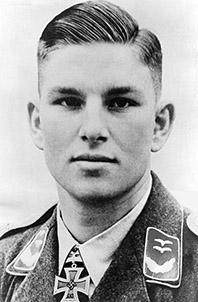
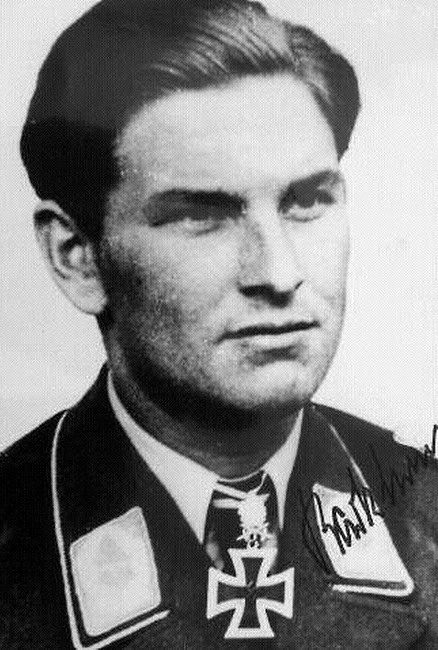
Gerhard "Gerd" Barkhorn (20 March 1919 – 8 January 1983) is credited with being the second most successful fighter ace of all time after fellow Luftwaffe pilot Erich Hartmann.
Recently researched information has shown that Barkhorn and/or Gunther Rall may have actually scored more confirmable victories than Hartmann, whose claim % has proven to be quite bad.
Barkhorn joined the Luftwaffe in 1937 and completed his training in 1939.Barkhorn flew his first combat sorties over Belgium and France during the Battle of France and later over southern England during the Battle of Britain, flying the Messerschmitt Bf 109E.On 1 August 1940 Barkhorn was transferred to 6./Jagdgeschwader 52 (JG 52).He did not have any success, although he flew some 21 combat sorties and was shot down in the English Channel on 29 October by RAF fighters.
Shortly thereafter he was rewarded with the Eisernes Kreuz erster Klasse (Iron Cross First Class). In the Staffel, he flew alongside another promising pilot, Hans-Joachim Marseille.
Barkhorn claimed 301 victories in 1,104 operational sorties. His total included 110 Yak fighters, 87 LaGG fighters, 21 Il-2s and 12 twin-engined medium bombers. He was shot down 9 times, bailed out once and was wounded 3 times.
Gerd received the frontflug-spange fur jager in gold in early July 1941 for completion of his 120th mission....
By November his tally had reached 10 victories and he was promoted to Oberleutnant on 11 November 1941.
Red Air Force DB-3
1528, Pe-2, NE of Petrovskaya @ 100m. 223 BAD, 2 VA. Losses believed to be in excess of 16 crews. Includes Divison CO Podpolkovnik I K Kosenko and Polkovnik Yuri N Gorbko HSU plus Lt. Ivan Sirko all KIA. 24 BBAP (Gorbko's unit) alone lost 6 Pe-2s
0945,LaGG-3, Kupyansk sector. Possibly from 170 IAP, 217 IAD, 4 VA. Ml.Lt. Vasily Pimenovich Bajdov KIA
1011, DB-7 Boston, 794 BAP, 221 BAD. 6 total losses including crew of Lt. Aleksey Stepanovich Cherkashenko (AE CO) lost in air combat this date. Ex-RAF serial AL267 was among the losses
On July 20, 1942, shortly after taking down his 56th opponent, he would receive the Luftwaffe Trophy of Honor.
five days later, he was wounded in combat while piloting his Bf 109F-4, which earned him 2 months in the hospital.
for having shot down a total of 59 aircraft.
0805, LaGG-3, 246 IAP. Lt. Vasily Makarovich Starodubtsev KIA (combat report stated that the pilot was seen to bale out)
LaGG-3, NE of Tuapse (PQ 95674) @ 2800m. These two claims likely against Ml. Lt. Aleksey Iosifovich Dogaev of 246 IAP, baled out safely (slight overclaiming). Note: All Barkhorn's victims reported to have baled out safely. (Also claimed by Werner Quast)
LaGG-3, Gunaiberg (PQ 95674) @ 2800m. Engagement was with 5 LaGG-3s of 246 IAP and 2 Yak-1s of 518 IAP, 236 IAD, 5 VA. These two claims were likely against the 518 IAP Yaks, which lost Lt. Sergey Mikhaylovich Kolesnikov (official report dates his loss 6.10.42) and St. Serzhant F.B. Varfolomeev
Yak-7B (claimed as a "Yak-1") 2km N of Altebinal (PQ 95732) @ 1200m. Possibly Podpolkovnik Dmitriy Leontyevich Kalarash (in a LaGG-3) of 402 IAP, 236 IAD. Said to be KIA in a Taran or WIA and returned home, DOW. Also possibility of Kapt. Segey Sergeevich Shchirov of 518 IAP
On 19 December 1942, Barkhorn had raised his score to 101 victories. That day, he became the 32nd Luftwaffe pilot to achieve the Century Mark of 100 kills.
103rd and 104th victories: 9.1.43/1245 and 1250. 2 x Yak-1s. Kuberke railway station/Simovniki sector. 236 IAP. Said to be Lev Shestakov and Mladshiy Leytenant Vasiliyev. both bellylanded and managed to escape before Barkhorn strafed the wrecks.
On 9 January 1943, Barkhorn claimed his 103rd & 104th kill. His victims included Lieutenant Vasiliyev, and Hero of the Soviet Union Podpolkovnik Lev Shestakov of the 236 IAP Fighter Regiment.
Barkhorn strafed both of their Yakovlev Yak-1 fighters until they caught fire. Both pilots survived.
Kuberke railway station/Simovniki sector. 236 IAP. Said to be Lev Shestakov and Mladshiy Leytenant Vasiliyev. both bellylanded and managed to escape before Barkhorn strafed the wrecks.
The very next day, Barkhorn shoots down Lev Shestakov a second time in two successive combat sorties.
10.1.43/0617 Yak-1 Remontnaja (Ramostnaja?) (PQ 28852) @ 2500m. Barkhorn is said to down Shestakov a second time in as many days
Barkhorn was awarded Oak Leaves to his Knight's Cross on 11 January 1943 for 105 victories.
0603 and 0610 2 x I-16s Kabardinka sector. Legitimate victories: 236 IAD, 5 VA. Two losse
Yak-1 (claimed as a “LaGG-3”) 8km NE of Mingrelskaja (PQ 86792) @ 4000m. 812 IAP, 265 IAD, 3 IAK, 4 VA. Leytenant G V Kramarenko, Leytenant A G Kostenko and Starshina I D Kukushkin. Ml.Lt. Konstantin Konstantinovich Adamchuk also severely WIA this date (several pilots claimed victories in the engagement)
Lend-lease Spitfire. 5km N of Cholmskaja (PQ 34 Ost 85161) @ 500m. 57 GIAP. Serzhant Marchenko reported MIA, later returned safely
In September, Barkhorn, now a Hauptmann with 164 victory credits, was appointed Gruppenkommandeur of II./JG 52 on 1 September 1943.
Bär had achieved his 19th and 20th victories on 22 June 1941 with a pair of Russian SB-2s, during a melee of the 39th SBAP.1130 and 1133 2 x SB-2s near Terespol VVS Western Front. SB losses include 130 SBAP, crew of Boris Vladimirovich Bastanzhiev (likely JG 51 victim, already damaged by Flak), they also lost crews of Mikhail Pavlovich Bugorkov and Pavel Borisovich Shakhmatov
1055 and 1105. 2 x La-5s (claimed as “LaGG-3s”) Poltava-Konontajew sector. One of these was a Hero and Ace from 41 GIAP, 2VA. Kpt. Nikolay Fedorovich Klepikov (HSU) KIA
1345 I-16 "Rata" near Nowo Histowka said to be from 161 IAP by at least one published source. Was it actually Ml.Lt. Vladimir Ivanovich Borisov of 163 IAP KIA?
On 5 September he shot down and killed Hero of the Soviet Union and Soviet fighter ace Nikolay Klepikov, an ace with 10 personal and 32 shared victories. This was offset by the loss of II./JG 52's 173-kill ace Oberleutnant Heinz Schmidt.
LaGG-3 (Claimed as a "Yak-1") Western end of Kolonka @ 2500m. 249 IAP. Mayor F N Kulyakin, Lt P M Batyrev and MlLt S I Karlamov all damaged in this engagement (Duettmann also claimed)
P-39 Airacobra (Claimed as a “Yak-1”) S of Eltigen @ 500m. 101 GIAP. Ml. Lt. Yakov Dementeev KIA
IL-2 Sturmovik E of Eltigen @ close to water's surface (Russian sources say into the sea, W of Taman). No. 1870571 of 210 ShAP, 232 ShAD. Ml. Lt. Valentin Elush KIA
The main German fighter unit covering the Crimea and Kuban was his II./JG 52, and in the three months between December 1943 and 13 February 1944, the unit claimed 350 victories of which 50 were claimed by Barkhorn personally.
On December 28th, 1943, Gerhard Barkhorn would have his name mentioned all throughout the Eastern Front...
He claims 7 aircraft shot down throughout the day, and shoots down several Russian Aces in combat that day...
St.Lt. Naumov 6 kills
Ml.Lt. Moskalev 4 kills
Kpt. Pechony 18.5 kills
St.Lt. Kankoshev 14
kills
0847 and 0853 LaGG-3 ("Yak-1") and IL-2 Sturmovik Kerch – Dzhankoi LaGG-3s of 88 IAP (1 loss) escorting IL-2s of 55 OKAE (no losses). St.Lt. Georgiy Ivanovich Naumov WIA (6 personal + 3 shared kills), died 31.12.43 of gangrene after amputation of both hands
victories 28.12.43/1020 and 1023 2 x LaGG-3s (claimed as "Yak-1s") Kap Chroni sector 790 IAP. Ml.Lt. Nikolai Georgievich Moskalev (3 personal + 2 shared kills) baled out but KIA, came down into icy water 1km E of Osoviny - One of these is an overclaim
Yak-1 Kertsch harbour basin @ 4500m 42 GIAP. Kapitan Nikolai Pechony (17 personal + 3 shared kills) belly landed WIA in face and arm
Yak-1 ("P-39 Airacobra") N of Baksy (Laksig) @ 4500m 66 IAP. Ml.Lt. Aleksandr Andrievskii safe
1812 and 1815 2 x Pe-2s SE of Nowgorod 261 BAP. Crews of Kapitan Yuriy Mykolayovych Garbko (AE CO, returned later with some of his crew), Lt. Alexander Ilyich Lyagushin and Lt. Nikolai Stepanovich Bocharov all shot down (third claim was made by Karl-Gottfried Nordmann so these are again legitimate victories)
During the second week in February 1944, with the mythical 250th kill on the horizon, Barkhorn stepped up his mission count and on February 12th 1944, he elevated himself to one of the greatest fighter pilots in the wo
Yak-1 ENE of Bulganak (PQ 66641) @ 3000m Possibly 48 GIAP. Ml.Lt. Yury Sergeevich Rubtsov MIA
Yak-1 25km SE of Rusa (PQ 66473) @ 2500m Was this No.22147 of 812 IAP? Ml.Lt. Sergey Semenovich Zuyev KIA
Yak-9 Mayak-Bakny area (PQ 66614) @ 2000m 42 GIAP and 249 IAP, 229 IAD, 4 VA and (most likely opponent) 979 IAP, 230 ShAD. Overclaiming, no losses
On 2 March 1944 he was awarded the Swords to his Knight's Cross. He attended the wedding of fellow ace Erich Hartmann as best man. Barkhorn was promoted to major on 1 May 1944..
0917 IL-2 Sturmovik mH Balaklava area or 10km S of Sevastopol (PQ 35473) @ 600m 47 ShAP. Losses were: Lt. N N Kuzmenko & M Serzhant G Mochalov, ditched near Belobek; Mladshiy Leytenant A N Mikhailenko & Serzhant N P Zhuvagin downed 5km from Lyubimovki plus ml. Lieutenant E.G.Udaltsov bellylanded back at base with shot-out hydraulics (two claims by Krah)
1655 and 1705 2 x P-39 Airacobras 10km S of Tudora (PQ 78643) Were these also from 129 GIAP, 205 IAD, 7 IAK? 153 IAP in action this day as well. against Fw190s without suffering any losses. 438 IAP lost Alexey Panfilovich Skripnikov KIA
0538 and 0545 P-39 Airacobras Husi/Lasi sector On the basis of timing, one of these may have been Kpt. Pawel K. Eryomin of 16 GIAP (said to have been downed near Zacharka in combat with Fw190, 0630ST)
On 31 May, on 273 victories, he was shot down by Soviet P-39 Airacobras.
Flying his sixth mission of that day he intercepted some Soviet bombers but failed to notice the escorting fighters.
His Bf 109G-6 was severely damaged and despite severe wounds to his right shoulder and leg he managed to crash-land behind his own lines, but was hospitalized for four months.
It has not been possible to identify the Soviet pilot who shot him down, but it was not, as some sources suggest, high scoring Soviet ace Aleksandr Pokryshkin who was not in the area at the time.
Eventually returning to his unit the psychological damage and combat stress on Barkhorn became apparent; sitting in his cockpit he became overcome with anxiety, and even when flying with friendly aircraft behind him he felt intense fear. It took several weeks for him to overcome this condition
Returning to combat
Yak-3 Jaszbereny area (PQ 98478) @ 2000m 3429214/"34" of 150 GIAP, 13 GIAD, 5 VA. Gv.lt. Agdantsev safe
1345 La-5 20km SW of Gyoergyoes (Gyongyos?) PQ 98452 39214932/"32" of 192 IAP, 279 IAD, 5 VA. Ml.Lt. Ol'nev WIA
40km ENE of Budapest (PQ 98615) @ 1500m Possibly overclaiming, no permanent La-5 loss this date
1500 Yak-1B ("Yak-3") 30km SW of Gyoergyoes (Gyongyos?) PQ 98622 @ 3500m 37191 of 149 GIAP, 13 GIAD, 5 VA. Ml.Lt. Vladimir Petrovich Isupov bailed out and returned on 19.11.44
Over the next few weeks Barkhorn added another 26 kills, scoring his 301st (and final) victory on 5 January 1945.
IL-2 Sturmoviks Likely legitimate victories: 17 VA lost 13 IL-2s this date
Yak-9s 17 VA lost 8 Yak-9s and 1 Yak-1B (No. 22167) this date
On January 4th, 1945, Barkhorn gets into combat with a gaggle of La-5's and shoots down 3 of them, and later that day, shoots down a Yak-9 for his 300th victory claim..
3 x La-5s 17 VA lost 1 La-5F and 3 La-5FN this date
Yak-9 17 VA lost 1 Yak-1B, 2 Yak-9D and 1 Yak-9T this date
On January 5th, 1945, he claims his last victory of the War... ~ 301st victory 5.1.45 La-5 Possibly an aircraft of 31 IAP or 116 IAP
Defense of the Reich
On 16 January 1945, Barkhorn was assigned as Geschwaderkommodore to Jagdgeschwader 6 (JG 6), a unit assigned to defend the Reich and equipped with the Focke-Wulf Fw 190D (although he preferred to retain his Bf 109G as well).
JG 6 was a unit consisting mostly of new recruits and former Bf-110 pilots; it suffered heavy losses against the American air fleets. Barkhorn did not last long in this position and was forced to take a medical absence because of severe physical and mental strain.
After his hospitalization, Barkhorn was invited by Adolf Galland to join the elite Jagdverband 44 (JV 44) flying the Messerschmitt Me 262 jet-fighter. He found flying the Me 262 over the western front difficult and he did not score any victories in it.
On 21 April 1945, he flew his 1104th and last mission. One of the engines of his aircraft flamed out as he was approaching an enemy bomber formation and he was forced to make an emergency landing.
🇺🇸As he approached the airfield, his jet was attacked by several prowling P-51 Mustang fighters.
Barkhorn managed to land his burning plane though he received a slight wound as a result of this action when the cockpit canopy - which he slid back prior to crash landing - slammed forward on his neck.
Taken prisoner by the Western Allies while still in hospital, he was released from Allied captivity in September 1945.
Barkhorn claimed 301 victories in 1,104 operational sorties. His total included 110 Yak fighters, 87 LaGG fighters, 21 Il-2s and 12 twin-engined medium bombers. He was shot down 9 times, bailed out once and was wounded 3 times.
Later life and service...
Barkhorn, after he was released as a prisoner of war, found work in the automobile industry. Following the decision of the Cabinet of Germany to rearm the Federal Republic of Germany, Barkhorn joined the military service of the Bundesluftwaffe in 1956.
From 1 April 1957 to 31 December 1962, he commanded the Jagdbombergeschwader 31 "Boelcke" (JaBoG 31—Fighter-Bomber Wing 31). In 1964 he was posted to the staff of Luftwaffen-Erprobungskommando (Air Force Test Command) holding the rank of Oberst.
Barkhorn was promoted to Brigadegeneral (brigadier general) in 1969 and to Generalmajor (major general) in 1973.
His last position was Chief of Staff of the Second Allied Tactical Air Force, a NATO military formation under Allied Air Forces Central Europe.
He retired from active service on 30 September 1975.
⚰On 6 January 1983, during a winter storm on an autobahn near Cologne, he and his wife Christl were involved in a car crash. His wife died instantly and Barkhorn, without regaining consciousness, died in hospital in Frechen/Cologne on 8 January 1983.
They were buried in Tegernsee, Bavaria.