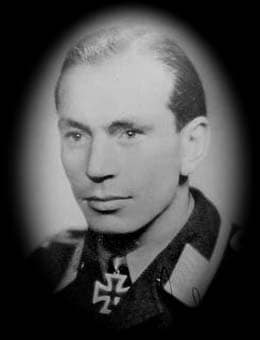
Faced with the success of his missions, Feldwebel Buchner was crowned Count with the Luftwaffe Honor Trophy on 2 October 1942.
On 1 February 1943, after four months hospitalisation due to illness, Buchner became a test pilot at the ERLA aircraft factory in Leipzig.
On 12 February, his Bf 109G-6 engine exploded at top speed at 22,500 feet. When he finally bailed out, he was very low and landed on a cooling tower, severely injuring his feet.
Hospitalisation followed until June 1943. In mid-July, he returned to his old 8./SG 1 unit, this time to fly the Fw 190A-4, and flew a further 200 missions as Schwarm Leader in a period of 6 months.
Buchner logged his 300th combat mission on 27 August 1943.
Shortly after being transferred to the 6./SG 2, Buchner was awarded the German Cross in Gold on 17 October 1943.
On 29 October 1943, he was wounded in aerial combat and did not return to his squadron for six weeks
On 23 January 1944, his Gruppe was transferred to the Crimea and, up until 9 May 1944, Buchner flew another 180 missions, was shot down twice, each time making an emergency landing.
He amazingly destroyed 26 enemy aircraft and 16 tanks during this period.
He flew his 500th mission on 4 March 1944.
Following his 500th combat mission, at the time credited with 13 aerial victories, he was nominated for Knight's Cross of the Iron Cross (Ritterkreuz des Eisernen Kreuzes).
TRIVIA: John Weal's silly book offers a profile of an Fw-190F-8 with an "Indianer Kopf" with black chevron for Buchner as Staffelkapitän 4./SG 2 in Zilistea/Romania, June 1944.
However, Hermann Buchner never flew an FW 190 marked '< + -'.
▪He did fly '<< + ' on one occasion. (September 1943)
'<I + ' on one occasion. (October 1943)
and '<C + ' on one occasion in May 1944.
▪At Zilistea during July 1944 he mostly flew 'G + ' on practice flights.
Supposedly, Buchner carried the "Indian Head" personal marking because his grandfather had been the tour manager for Sitting Bull's travelling show in Europe and his family held much Sioux memorabilia.
5 April 1944, in a fierce combat against Il-2 Sturmoviks attacking German troops, Buchner knocked down no less than FOUR of the attacking ground attack aircraft.
Buchner's unit was the last to leave the Crimea, moving on 9 May 1944 to Romania, to protect the oilfields in the fighter role.
His 600th combat mission was completed in early June 1944.
His 600th mission is celebrated in picture form with his Fw-190F-8 "Green Y."
From 1 June 1944 to 1 August 1944, Buchner was appointed as Staffelführer (acting squadron leader) of 4. Staffel of SG 2.
Shortly after his appointment, his unit was allocated to Romania.
His opponents were American aircraft operating from Italy. In Buchner's first encounter with the P-51 Mustang, his two Fw 190s were outnumbered 15 to 1 and he unfortunately lost his wingman.
In this area, Buchner flew 35 combat missions, destroyed five tanks and shot down eight aircraft.
On 20 July 1944, Buchner was finally awarded the Knight's Cross of the Iron Cross.
At the time, he had been credited with 47 aerial victories, including a Boeing B-17 bomber over Romania, and as a ground attack pilot with 6. Staffel (6th squadron) of SG 2, Buchner was credited with 46 Russian tanks destroyed in over 500 combat missions.
The presentation was made by Oberst Alfred Druschel.
The P-38F-5 (work-number 43-28619) belonged to the 22nd Photographic Reconnaissance Squadron and was piloted by Second Lieutenant Irvin J. Rickey, who bailed out and became a prisoner of war.
In early December 1944, newly promoted to Leutnant , Buchner was transferred to III./JG 7 ( Gruppe III of Jagdgeschwader 7), under the leadership of Oberst Jo-hannes Steinhoff.
Buchner flew a further 19 missions with III. Gruppe of Jagdgeschwader 7 (JG 7—7th Fighter Wing) with the Me 262 and claimed eleven more aircraft shot down before the end of the war.
On 18 January 1945, Buchner married the Red Cross nurse Käthe.
By the end of the year 1943, his tally would reach 73 confirmed victories, 24 of these victories in 6 weeks;
among them four each on 25 October 1943 and 15 November 1943.
Four days later on 28 April, Heinrich once again gets into a serious dogfight over Laibach and quickly destroys
2x Mustangs of the 352nd FG, one of them Lieutenant Colonel Clark.
Hermann Buchner, already an Ace decorated with the Knights Cross, describes an attack:
"On 31 March there was something new for us — an early scramble. We were still at breakfast in the dining room and the weather was not very good with a cloud base 150-200 metres above the ground.
We flew with seven 262s led by Oberleutnant Schall, one Schwarm and one Kette. Our mission was against US units in the Hannover region, with take off at 0900hrs. We climbed in tight formation into the clouds, heading westwards.
The clouds just weren’t coming to an end and Schall asked the ground station guiding us whether we should make ‘Luzi-Anton 5’. A brusque answer came back over the radio: ‘First of all make Pauke-Pauke“
At 7,500 metres above ground, we had just come out of the clouds when Schall got the order: ‘Assume course 180, Dicke Autos, course 180!’
At the same moment someone from our unit cried, ‘To the right of us, nothing but bombers, to the right of us!’ Schall, as well as the rest of us, saw the bombers, flying north in a fomiation that was new to us. They flew staggered, about 1,000 metres deep and 2,000 metres wide.
They were not US bombers, however, but Tommys in night-flight formation, doing a daytime attack on Hamburg.
Schall ordered us to take up attack formation, already having long forgotten the order ‘assume 180’. We were lucky to reach the band without fighter protection and Schall, a fighter with real heart, was not going to pass up a chance like this.
As we got closer we could clearly see what kind of bombers they were — RAF Lancasters — on their way to attack Hamburg, but still 50km away over the Luneberg Heath.
On our first attack, seven Lancasters were shot down with the R4M rockets. Now the large unit dissolved somewhat and the Rotten flew a renewed attack on the bombers.
I made a right turn and lined up for another attack, using the nose cannon.
My Lancaster lay directly in my sights and I only had to get a bit closer. I opened fire, the hits were good, but the pilot of the Lancaster must have been an old hand. He turned his Lancaster steeply over on its right wing, making a tight turn around the main axis.
With my speed I was unable to follow this tight manoeuvre and was also unable to see if my shots had had any effect, or to see how he flew on.
I shot through the pile and had to think about returning home. The other pilots were also having the same problem. We had a shortage of fuel and had to get back to our own garden. At the same time, all called to the ground control ‘Autobahn’, for the course number for the direction back to our home airfield.
Only one of us could be handled by ‘Tornado’ ground control, but all of us wanted to be given a course.
We were still all in the tangle of RAF bombers, but none of us had visual contact with each other. We all had to go back down through the cloud layer. I thought to myself, ‘Go back down alone!’
At 7,000 metres I dived into the cloud layer, laying on a course of 090, 700kmph and the engines running at 6,000rpm.
Over the radio I could still hear my colleagues calling ‘Autobahn’ to ‘Tornado’ — they were all still in the air. My altimeter showed that I was quickly losing height, and at 1,000 metres it was already dark — I had to get out of the clouds soon.
My altitude was diminishing, the gauge showing 500, 400, 300 metres — the ground must surely soon appear. Yes, there it was. Doing 700kmph I shot out of the clouds and found myself over fields and clumps of trees. Unfortunately I didn’t know quite where I was. On my left side I could make out the sea — was it the Baltic, or where was I?
Anyhow, I flew eastwards with a normal turbine rpm and at 800kmph. In the distance I could see the silhouette of a town. I quickly thought about it, then I was sure that the town had to be Lubeck. I had recently seen a film called Die Budenbrocks in which the silhouette of the town had been shown. Flying over the harbour, I came under fire from light flak, but I was too fast — they had no chance of hitting me.
Now I knew how I could get back. My other comrades were also on their journey back to Parchim, and now the traffic with ‘Tornado’ was quieter, so I could also call up and ask for instructions, giving him my location. I was the last 262 to call in after the mission at 7,000 metres. Now he had his flock together.
By the time I reached Ludwigslust I had already been given permission to land, as well as the comforting news that there were ‘no Indians on the airfield’. After 65 minutes flying I landed without difficulty in Parchim, the last of the seven.
My list of aircraft shot down was extended: one Lancaster confirmed and one definitely damaged. Altogether we had certainly shot down ten Lancasters and five others had been damaged.“ The seven 262s on the mission had landed without problems after 60-70 minutes flying time in bad weather conditions. The reported aerial victories were confirmed by Jagd Division, and the bombers had offloaded their cargoes over the heath, far from their target. Around sixty flying personnel were taken prisoner on the heath."
On April 8 1945, Buchner's 262 was shot ablaze by a strafing Mustang while he was landing.
The next day, more than a hundred Luftwaffe aircraft, including a large number of Me 262s, were destroyed in airbase raids.On 10 April 1945, twenty-seven out of fifty-five Me 262s that had been dispatched against U.S. heavy bombers were shot down.
It is believed that JG 7’s jets accounted for at least 480 enemy aircraft shot down before the war ended.
On 21 April 1945, after being shot down by flak of the US 559th AAA in Me 262A-1a WNr 501221'Yellow 3', Buchner made a forced landing by a rail line near Klötze and was taken prisoner and became a POW.
Buchner would fly no more with the Me 262. He ended the war as an Oberfeldwebel.
He is credited with 58 aerial victories; 45 on the Russian front and 13 on the western front, with 12 victories flying the Me 262 in Defence of the Reich.
After the surrender of German Forces and his release, Buchner found employment with the occupying American Army.
Buchner, in the two years following World War II, served as an observer in the weather service of the American occupation forces.
 Nazi Germany
 Luftwaffe
 Knight's Cross of
the Iron Cross
Knight's Cross of
the Iron Cross

 Leutnant