Fenrir's Binding

Tyr's Sacrifice


Idun

“unknown artist"

Loki's Offspring

The Norse pseudo-god Loki, who is by turns the friend and the enemy of the other gods, had three fearfully hideous and strong children with the giantess Angrboda (“She Who Bodes Anguish”). The first was the serpent Jormungand, and the second was the death-goddess Hel. The third was the wolf Fenrir.

Foreboding

The gods had terrible forebodings concerning the fate of these three beings. And they were absolutely correct. Jormungand would later kill the god Thor during Ragnarok, the downfall of the cosmos, an event which would be largely brought about by Hel’s refusal to release the radiant god Baldur from the underworld. During these cataclysmic events, Fenrir would devour Odin, the chief of the gods.

Each it's Own

In order to keep these monsters at bay, they threw Jomungand into the ocean, where he encircled Midgard, the world of humankind. Hel they relegated to the underworld. Fenrir, however, inspired too much fear in them for them to let him out from under their watchful eyes, so they reared the pup themselves in their stronghold, Asgard. Only Tyr, the indefatigable upholder of law and honor, dared to approach Fenrir to feed him.

Fenrir grew at an alarming rate, however, and soon the gods decided that his stay in Asgard had to be temporary. Knowing well how much devastation he would cause if he were allowed to roam free, the gods attempted to bind him with various chains. They were able to gain the wolf’s consent by telling him that these fetters were tests of his strength, and clapping and cheering when, with each new chain they presented him, he broke free.

Svartalvr

At last, the gods sent a messenger down to Svartalfheim, the realm of the dwarves. The dwarves, being the most skilled craftspeople in the cosmos, were able to forge a chain whose strength couldn’t be equaled; it was wrought from the sound of a cat’s footsteps, the beard of a woman, the roots of mountains, the breath of a fish, and the spittle of a bird – in other words, things which don’t exist, and against which it’s therefore futile to struggle. Gleipnir (“Open”) was its name.

Gleipnir

When the gods presented Fenrir with the curiously light and supple Gleipnir, the wolf suspected trickery and refused to be bound with it unless one of the gods would lay his or her hand in his jaws as a pledge of good faith. None of the gods agreed, knowing that this would mean the loss of a hand and the breaking of an oath. At last, the brave Tyr, for the good of all life, volunteered to fulfill the wolf’s demand. And, sure enough, when Fenrir discovered that he was unable to escape from Gleipnir, he chomped off and swallowed Tyr’s hand.

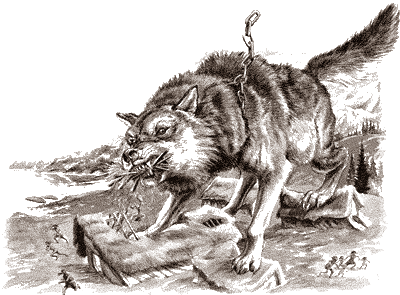
The fettered beast was then transported to some suitably lonely and desolate place. The chain was tied to a boulder and a sword was placed in the wolf’s jaws to hold them open. As he howled wildly and ceaselessly, a foamy river called “Expectation” (Old Norse Ván) flowed from his drooling mouth. And there, in that sordid state, he remained – until Ragnarok

Tyr

Of all of the surviving Norse myths, this tale is the only one that prominently features Tyr. Without it, we wouldn’t understand Tyr’s character or role nearly as well as we can with the help of this myth.

Many people who have only a passing knowledge of Norse mythology think of Tyr as a war god. That he certainly was, but virtually all of the Norse gods and goddesses had something or another to do with war. Tyr, like all of the other Norse war gods, was far more than only a war god.

This myth powerfully illustrates Tyr’s role as the divine legal expert and upholder of the law. In the words of the celebrated scholar of comparative religion Georges Dumézil, when Tyr sacrifices his hand, “he not only procures the salvation of the gods but also regularizes it: he renders legal that which, without him, would have been pure fraud.”[4] The gods had sworn an oath to Fenrir, and the guarantee of their intention to follow through with their pledge was Tyr’s hand (or arm – the percentage of the limb bitten off by Fenrir is irrelevant). When the gods didn’t follow through with their oath, Fenrir was entitled to Tyr’s hand as compensation. By allowing the wolf to claim his limb, Tyr fulfilled the gods’ end of the bargain, grisly and tragic though it was for him.


This is one token of his daring: when the Æsir enticed Fenris-Wolf to take upon him the fetter Gleipnir, the wolf did not believe them, that they would loose him, until they laid Týr's hand into his mouth as a pledge. But when the Æsir would not loose him, then he bit off the hand at the place now called 'the wolf's joint;' and Týr is one-handed, and is not called a reconciler of men.

— Gylfaginning .
--

The Binding of fenrir

The children of Loki and the witch Angerboda were not as the children of men: they were formless as water, or air, or fire is formless, but it was given to each of them to take on the form that was most like to their own greed.

The Gods feared all three of Loki’s offspring, and with good reason! Hel’s refusal to release Baldur from the Underworld would bring the final battle of Ragnorok ever closer, Jormungandr would kill the God of Thunder ‘Thor’, and the mighty wolf Fenrir would devour the Al father ‘Odin’ himself.

Now the Dwellers in Asgard knew that these powers of evil had been bom into the world and they thought it well that they should take on forms and appear before them in Asgard. So they sent one to Jamvid, the Iron Wood, bidding Loki bring before the Gods the powers bom of him and the witch Angerboda. So Loki came into Asgard once more. and his offspring took on forms and showed themselves to the Gods.

The first, whose greed was destruction, showed himself as a fearful Wolf. Fenrir he was named. And the second, whose greed was slow destruction, showed itself as a Serpent. Jormun- gand it was called. The third, whose greed was for withering of all life, took on a form also. When the Gods saw it they were affrighted. For this had the form of a woman, and one side of her was that of a living woman and the other side of her was that of a corpse. Fear ran through Asgard as this form was revealed and as the name that went with it, Hela, was uttered.

Far out of sight of the Gods Hela was thrust. Odin took her and hurled her down to the deeps that are below the world. He cast her down to Niflheim, where she took to herself power over the nine regions. There, in the place that is lowest of all, Hela reigns. Her haU is Elvidnir; it is set round with high walls and it has barred gates ; Precipice is the threshold of that hall ; Hunger is the table within it ; Care is the bed, and Burning Anguish is the hanging of the chamber.

Thor laid hold upon Jormungand. He flung the serpent into the ocean that engirdles the world. But in the depths of the ocean Jormungand flourished. It grew and grew until it en- circled the whole world. And men knew it as the Midgard Serpent.

Fenrir the Wolf might not be seized upon by any of the AEsir. Fearfully he ranged through Asgard and they were only able to bring him to the outer courts by promising to give him all the food he was able to eat. The Aesir shrank from feeding Fenrir. But Tyr, the brave swordsman, was willing to bring food to the Wolf's lair. Every, day he brought him huge provision and fed him with the point of his sword. The Wolf grew and grew until he became monstrous and a terror in the minds of the Dwellers in Asgard.

At last the Gods in council considered it and de- cided that Fenrir must be bound. The chain that they would bind him with was called Laeding. In their own smithy the Gods made it and its weight was greater than Thor's hammer.

Not by force could the Gods get the fetter upon Fenrir, so they sent Skirnir, the servant of Frey, to be- guile the Wolf into letting it go upon him. Skimir came to his lair and stood near him, and he was dwarfed by the Wolf's monstrous size.

"How great may thy strength be. Mighty One?" Skirnir asked. "Couldst thou break this chain easily? The Gods would try thee. "

In scorn Fenrir looked down on the fetter Skimir dragged. In scorn he stood still allowing Laeding to be placed upon him. . Then, with an effort that was the least part of his strength, he stretchedhimself and broke the chain in two.

The Gods were dismayed. But they took more iron, and with greater fires and mightier hammer blows they forged another fetter. Dromi, this one was called, and it was half again as strong as Laeding was. Skimir the Venturesome brought it to the Wolf's lair, and in scorn Fenrir let the mightier chain be placed upon him.

He shook himself and the chain held. Then his eyes became fiery and he stretched himself with a growl and a snarl. Dromi broke across, and Fenrir stood looking balefully at Skirnir.

The Gods saw that no chain they could forge would bind Fenrir and they fell more and more into fear of him. They took council again and they bethought them of the wonder-work the Dwarfs had made for them, the spear Gungnir, the ship Skidbladnir, the hammer Miolnir. Could the Dwarfs be got to make the fetter to bind Fenrir ? If they would do it the Gods would add to their domain.

Skirnir went down to Svartheim with the message from As- gard. The Dwarf Chief swelled with pride to think that it was left to them to make the fetter that would bind Fenrir.

"We Dwarfs can make a fetter that will bind the Wolf," he said. "Out of six things we will make it."

""What are these six things?" Skimir asked.

  •  The sound of cats footsteps
  •  The beard of a women
  •  (Roots of a mountain in some translations) Sinews of Bears
  •  The breath of a fish
  •  The spittle of a bird

"I have never heard the noise made by a cat's footfall, nor have I seen the roots of stones nor the beards of women. But use what things you will, O Helper of the Gods." The Chief brought his six things together and the Dwarfs in their smithy worked for days and nights. They forged a fetter that was named Gleipnir. Smooth and soft as a silken string it was. Skirnir brought it to Asgard and put it into the hands of the Gods.

Then a day came when the Gods said that once again they should try to put a fetter upon Fenrir. But if he was to be bound they would bind him far from Asgard. Lyngvi was an island that they often went to to make sport, and they spoke of going there. Fenrir growled that he would go with them. He came and he sported in his own terrible way. And then as if it were to make more sport, one of the ^sir shook out the smooth cord and showed it to Fenrir.

"It is stronger than you might think, Mighty One," they said. "Will you not let it go upon you that we may see you break it?"

Fenrir out of his fiery eyes looked scorn upon them. "What fame would liiere be for me," he said, "in breaking such a binding?"

They showed Vn'm that none in their company could break it, slender as it was. "Thou only art able to break it. Mighty One," they said.

"The cord is slender, but there may be an enchantment in it," Fenrir said.

"Thou canst not break it, Fenrir, and we need not dread thee any more," the Gods said.

Then was the Wolf ravenous wroth, for he lived on the fear that he made in the minds of the Gods. "I am loth to have this binding upon me," he said, "but if one of the ^sir will put his hand in my mouth as a pledge that I shall be freed of it, I will let ye put it on me."

The Gods looked wistfully on one another. It would be health to them all to have Fenrir bound, but who would lose his hand to have it done? One and then another of the ^sir stepped backward. But not T3t:, the brave swordsman. He stepped to Fenrir and laid his left hand before those tremendous jaws.

"Not thy left hand — thy sword-hand, Tyr," growled Fenrir, and Tyr put his sword-hand into that terrible mouth.

Then the cord Gleipnir was put upon Fenrir. With fiery eyes he watched the Gods bind him. When the binding was on him he stretched himself as before. He stretched himself to a monstrous size but the binding did not break off him. Then with fury he snapped his jaws upon the hand, and Tyr's hand, the swords- man's hand, was torn off.

But Fenrir was bound. They fixed a mighty chain to the fetter, and they passed the chain through a hole they bored through a great rock. The monstrous Wolf made terrible efforts to break loose, but the rock and the chain and the fetter held. Then see- ing him secured, and to avenge the loss of Tyr's hand, the Gods took Tyr's sword and drove it to the hilt through his under-jaw. Horribly the Wolf howled. Mightily the foam flowed down from his jaws. That foam flowing made a river that is called Von — a river of fury that flowed on until Ragnarok came, the Twilight of the Gods.