Iduna 's Apples

The Wall of Asgard's Consequences


Idun

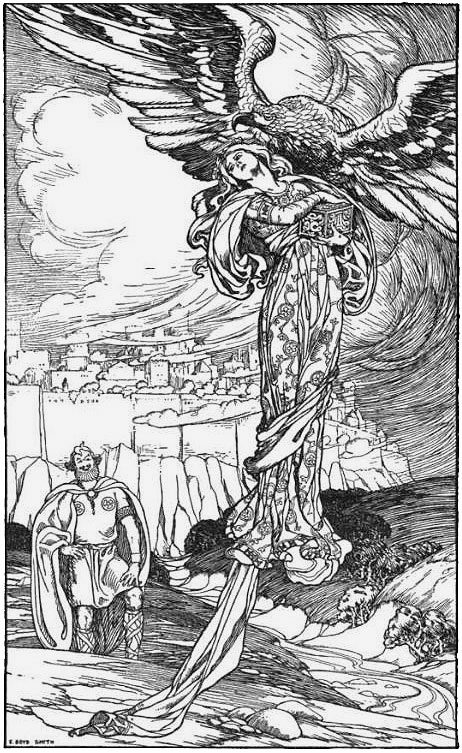
“"Idun being seized by the giant Thiassi, illustration by E. Boyd Smith, c. 1902."

Idun's Apples

Idun (pronounced “IH-dune;” from Old Norse Iðunn, “The Rejuvenating One”) is a goddess who belongs to the Aesir tribe of deities. Her role in the pre-Christian mythology and religion of the Norse and other Germanic peoples is unfortunately obscure, but she features prominently in one of the best-known mythological tales, The Kidnapping of Idun. In this tale, which comes to us from the skaldic poem Haustlöng and the Prose Edda, Idun is depicted as the owner and dispenser of a fruit that imparts immortality.

In modern books on Norse mythology, these fruits are almost invariably considered to be apples, but this wasn’t necessarily the case in heathen times. The Old Norse word for “apple,” epli, was often used to denote any fruit or nut, and “apples” in the modern English sense didn’t arrive in Scandinavia until late in the Middle Ages.[2] Whatever species Idun’s produce belongs to, its ability to sustain the immortality of the gods and goddesses makes Idun an indispensable presence in Asgard.

Idun is the wife of Asgard’s court poet and minstrel, Bragi and daughter of a dwarf blacksmith, Ivald, and the goddess of eternal youth, spring, love, and fertility was the keeper of the golden apples of youth, which she maintained in her magic casket. One Old Norse poem has Loki accuse her of sleeping with her brother’s murderer, but the identities of her brother and his slayer are unknown, and no tale explaining this accusation has survived into the modern era.

Unfortunately, that’s about all we know about Idun, due to the sparseness of mentions of her in the sources of our present-day knowledge of Norse mythology and religion.

Loki gets played

Odin, Loki and Honir crossed into Midgard, happy in one another’s company, and in- tent upon exploring some part of the earth not already known to them.

In the pale blue, almost pale green light that gives an edge to everything, the three friends crossed a desolate reach of grit, patrolled only by the winds. Before men in Midgard had stirred and woken, the gods were striding over scrubby, undulating ground. Then they tramped round a great mass of spiky, dead, dark rock, and headed for the summit of a conical mountain.

All day they trekked and talked and, in the evening, they followed the course of a rapid, milky river from a glacier down into a valley — a jigsaw of fields, yellow and brown and green.

Odin, Loki and Honir had not brought any food with them and were beginning to feel very uneasy about it when they had the luck to come across a herd of oxen. While Loki sized them up, chose one and killed it, Odin and Honir gathered fallen branches from a grove of stunted oaks and made a fire. Then they cut up the ox into huge pieces and put the pieces into the heart of the fire.

The smell ravished the gods; they could barely wait to eat. As soon as they thought the joints were roasted, they scattered the fire and pulled the meat out of the flames.

‘It’s not ready,’ said Odin, surprised. ‘We must be so hungry that a little time seemed long to us.’

Loki and Honir raked up the brands and put the meat back into the fire again.

Suddenly a chill wind channelled down the valley. Although the sun still loped across the western sky with the wolf at its heels, all the heat had drained out of the summer day. The three gods wrapped their cloaks around them and sat and waited.

`Do you think it’s ready?’ asked Honir. ‘What do you think? Shall I find out?’

‘One of these days, you’ll choke on your own uncertainty,’ Loki said, leaping to his feet and scattering the fire for a second time. ‘It must be cooked by now.’

Odin took a piece out of the flames. ‘It’s still not ready,’ he said. And it ought to be.’

‘There’s nothing wrong with this fire,’ Honir said. ‘And yet our dinner is as raw now as it was to begin with,’ said Loki, looking at the meat and grimacing. ‘Well,’ said Odin, ‘something is working against it.’ ‘Something sitting up here,’ said a voice from above them. The three gods at once looked up into the leafy branches of the oak tree above the fire. They looked and they saw an eagle sitting there, and it wasn’t a small one. ‘Let me eat my fill,’ said the eagle to the three upturned faces, ‘and your ox will be cooked.’

The gods conferred and were of one mind. ‘Since we too want to eat tonight,’ Odin told the eagle, ‘we agree. There is nothing else we can do.’ Then the eagle screeched. It flapped its immense wings, swooped down from the tree and settled over the fire. At once it snatched up both the shoulders and both parts of the rump as well. Then it eyed the gods and, crouching at the root of the oak, began to eat. Loki was so angry that he raised his staff and rammed it into the bird’s body. The eagle was thrown off balance and dropped the meat. It screeched again and took to the air. One end of the staff was firmly lodged in the eagle’s back; and, to his alarm, Loki found that he was unable to let go of the other. He pulled and twisted and yelled to no purpose. His hands were stuck to the staff.

The eagle flew at great speed and it took care to fly close enough to the ground to make sure that Loki did not have a smooth ride. The Trickster was dragged across the floor of Midgard. His knees and ankles hanged into boulders; his legs and feet were scratched by gorse bushes and thorns until they were bleeding. ‘Mercy!’ shouted Loki.

The eagle took no notice. It dragged Loki on his backside across a glacier until he was all but skinned. ‘Mercy!’ yelled Loki again. He thought his outstretched arms were going to be wrenched from their sockets. ‘Only,’ said the eagle, rising to give Loki a little respite, ‘only if you will swear . ‘What?’ shouted Loki. ‘Anything! Mercy!’ ‘Only if you will swear to bring Idun and her apples out of Asgard.’ Loki closed his eyes and pressed his lips together and said nothing.

He knew now that the eagle could only be one of the giants, in disguise. The eagle swooped again and Loki could hardly bear the pain as his knee-caps and shins and ankles and toes cracked against rocks and boulders and scree. ‘Mercy!’ implored Loki. ‘I promise you. I swear it.’ ‘Seven days hence,’ said the eagle. ‘Lead Idun over Bifrost when the sun is half-way between east and west.’ ‘I promise,’ called Loki.

The Trickster found that his hands were at once set free and he fell to the stony ground. Very slowly he picked himself up and looked at his wounds. Then, in the gathering darkness, he began to limp back towards his companions.

The Trap

Seven days passed and Loki found Idun wandering through the sloping field above her hall. She was singing softly to herself, and was quite carefree; the sun caressed her. Childlike she moved, untroubled by the world’s troubles around her, petty squabbles, suffering, savage wars, and, always, time passing. Her basket of golden apples was looped over one arm. ‘Idun!’ called Loki. Bragi’s wife paused and turned. ‘I’ve come at once. You can’t imagine; I could scarcely believe it myself.’ ‘Speak more simply,’ said Idun.

‘Deep in the forest just beyond Bifrost, I came across a tree quite unlike the others. Unlike any tree I’ve seen in the nine worlds. It stands in a glade and it glows with a soft light.’ Idun opened her grey eyes wide, and Loki went on to describe his find so carefully that anyone less trusting would have known it came straight out of his head.

‘Idun, it bears golden apples,’ he said, jabbing with his forefinger at one of the apples in the basket. ‘The same as yours. And perhaps, like yours, they contain unending youth. We should take them at once for the gods.’ Idun smiled and nodded in agreement. ‘Don’t forget your own apples. We must compare them,’ said Loki, and he led the way over the sunlit field and out of Asgard. They hurried past Heimdall’s hall and then Loki took Idun by the hand and walked with her over Bifrost. The flames danced around their feet and they were unharmed.

The eagle was waiting. As soon as Idun set foot in Midgard, it rose from a thicket. It beat its dark wings, swooped on the goddess, and snatched her up. It carried her and her apples straight over the sea to Jotunheim — for as Loki had suspected, the eagle was none other than a giant. It was Thiazi.

Thiazi lifted Idun to his storm-home at Thrymheim, high in the mountains. ‘Here you’ll stay,’ he gloated. ‘Without you, without your apples, the gods will age, and I will remain young for ever.’

The Culprit

When they missed Idun, the gods at once grew extremely anxious. They knew that without her magic apples, they would wither and grow old. And, indeed, they soon began to crumple inside their clothes and to seem smaller than they were before. Their skin hung over their bone- houses, bunched or puffy or wrinkled, or stretched so tight that it looked as though the bone would break through. The eyes of one became bloodshot and the eyes of another misty; one god’s hands began to tremble, one lost all his hair, and one could not control his bowels. Their joints creaked and ached and they felt utterly limb-weary. The gods felt the spring in their step and the strength in their bodies ebbing from them hour by hour. Then the minds of the gods lost their skip and started to soften. One became outspoken about the shortcomings of the others and one began to ramble like an idiot, but most of the gods grew quiet and did not trouble to say many things they would have said before. And they were all obsessed by the same concern with time, the same fear. When they did speak, they repeated themselves; or they began sentences and did not complete them. The summer sunlight shone on Asgard, flocculent clouds drifted overhead, and the minds of the gods wandered even as they worried about their old age. Odin knew he must rally his own strength and summon the gods to council. Everyone in Asgard made his way to Gladsheim, a dismal straggling procession under the sun. Of all the gods and goddesses and their servants, only Idun and Loki were missing. Allfather looked at the great gathering of stooping, shuffling, mumbling figures. ‘We must find Idun,’ he called. ‘You see how it is without her, without her apples. And it will grow worse. Who was the last to see her?’ ‘I saw Loki lead Idun over Bifrost,’ said Heimdall’s servant. There was a deep silence in Gladsheim. No one doubted then that Loki was the cause of what had happened to them. ‘There is only one thing to do,’ said Odin. ‘We must capture Loki.’ Weary as they were, the gods searched for the Trickster; they looked in every hall and outbuilding, and in every copse and corner of Asgard; they knew their lives depended on it. At last they found him asleep in Idun’s own field, and they seized and bound him before he could do anything about it. Loki was brought to Valaskjalf, protesting, and there Odin at once charged him with leading Idun out of Asgard. ‘Bring her back,’ said Allfather. ‘Your choice is easy to explain and easy to understand. Bring Idun and her apples back. Otherwise we’ll put you to death.’ ‘It is true,’ said Loki, ‘that I walked out of Asgard with Idun. But then I had no choice.’ Loki told them how the eagle that had carried him off when he was trekking with Odin, and Honir was none other than the giant Thiazi. ‘And I had to agree to those threats to escape with my life,’ said Loki. ‘Did you have to fulfil them?’ asked Odin. Loki’s eyes gleamed, red and green. ‘Since you consort with eagles,’ said Odin, ‘we’ll draw a blood-eagle on your back.’ ‘No,’ said Loki, and he shrank before Odin’s savage eye. ‘And your rib-cage will spring apart.’ ‘No,’ said Loki, cowering. ‘Like wings,’ said Odin and his teeth were clenched. ‘I will find Idun and her apples,’ said Loki. ‘If Freyja will lend ine her falcon skin, I’ll fly at once into Jotunheim. I swear it.’ Then Odin shook and released Loki and Freyja, beautiful Freyja, her face like a pouch now and her hair falling out, went directly to her hall with him. She pulled down the falcon skin hanging over one of the beams. ‘You’re not quite so beautiful now that you’re bald,’ said Loki. Freyja said nothing. Her body shook. She wept tears of gold and handed Loki the falcon skin.

The Sly One

Thrymheim perched on the top of a precipitous sgurr and seemed actually to grow out of the dark rock. The winds whirled round it, and found their way through the walls into the cold, draughty rooms. When Loki reached it in the early evening, he was fortunate enough to find the giant Thiazi was not at home. He had gone off fishing, and his daughter Skadi had gone with him.

Loki discovered Idun in a smoky room, huddled over a fire. She turned to him and at once the schemer extended his falcon wings; he murmured the runes, the magic words, and turned Idun into a nut. Then he picked her up between his claws and flew off as fast as he could.

In a little time, Thiazi and his daughter returned from the day’s fishing. When the giant found that Idun was no longer there, he roared and hurled his pails to the ground. He knew there was no way in which the goddess could have escaped from Thrymheim without help.

Then Thiazi donned his eagle skin for a third time and set off across the mountains and the high lifeless wilderness. The distance from Thrymheim to Asgard was immense and the eagle was stronger than the falcon. As Loki drew closer to Asgard, so Thiazi drew closer to Loki.

Redemption

When he sat in Hlidskjalf looking over the nine worlds, nothing escaped Odin: no movement of man or giant or elf or dwarf, bird in the air or animal on earth or fish in the water. What other gods could not see at all, Allfather fixed and followed with his single eye. Now he saw Loki flying at great speed towards Asgard and the eagle Thiazi chasing him. At once he ordered all the gods and goddesses and their servants, worn out and short-winded as they were, to hurry out of Asgard with bundles of plane shavings, all the wood that the servants of the gods prepared to kindle fires in their great halls. ‘Pile them up against the walls,’ said Odin. ‘Loki is coming.’

The still summer air began to hum, as if an unseen storm were near and about to burst on them. It began to throb and then the gods and goddesses saw the falcon, and the huge eagle close behind it. From a great height the falcon dived down over the walls of Asgard, still holding the nut between its claws. ‘Light the shavings!’ cried Odin. ‘The shavings!’

The flames leaped up, almost unseen in the bright sunlight. The eagle was so close behind the falcon that he could not stop himself; he Flew straight through the flames; his wings caught fire. Thiazi blundered on into Asgard, and fell to the ground in torment. Then the gods stumbled back through the gates into their citadel and quickly killed him there.

Loki threw off Freyja’s falcon skin. He looked at the grey, aged, anxious ones pressing around him, and scornfully laughed in their faces. Then the Sky Traveller bent over his trophy; he cradled it between his hands and softly spoke the runes.

Idun stood there, young and supple and smiling. She moved innocent among the ailing gods. She offered them apples.



The bird of blood [eagle], happy with its booty, flew a long distance with the wise god, so that the wolf’s father [Loki] was about to rip in two. Then Thor’s friend — heavy Lopt [Loki] had collapsed — was forced to beg Midiung’s mate [the giant] as hard as he could for quarter.

The scion of Hymir’s race [giants] instructed the crew-guider, crazy with pain, to bring to him the maid who knew the Æsir’s old-age cure [Idunn]. The thief of Brising’s girdle [Brisingamen] afterwards caused the gods’ lady [Idunn] to go into the rock-Nidud’s [giant’s] courts to Brunnakr’s bench.

— Þjóðólfr of Hvinir, Haustlöng, 8–9 [Skáld. 22–23], trans. A. Faulkes, 1987.
--

Iduna’s Apples

In Asgard there was a garden, and in that garden   there grew a tree, and on that tree there grew shining   apples.

Thou knowst, O well-loved one, that every   day that passes makes us older and brings us to that   day when we will be bent and feeble, grey-headed   and weak-eyed. But those shining apples that grew in Asgard , those who ate of them every day grew never a day older, for the eating of the apples kept old age away.

Iduna, the Goddess, tended the tree on which the shining apples grew.
None would grow on the tree unless she was there to tend it.
No one but Iduna might pluck the shining apples.
 Each morning she plucked them and left them in her basket and every day the Gods and Goddesses came to her garden that they might eat the shining apples and so stay forever young.

Iduna never went from her garden. All day and every day she stayed in the garden or in her golden house beside it, and all day and every day she listened to Bragi, her husband, tell a story that never had an end.

Ah, but a time came when Iduna and her apples were lost to Asgard, and the Gods and Goddesses felt old age approach them.

How all that happened shall be told thee,

 O well-beloved. Odin, the Father of the Gods, often went into the land of men to watch over their doings.
Once he took Loki with him, Loki, the doer of good and the doer of evil. For a long time they went travelling through the world of men. At last they came near Jotunheim, the realm of the Giants. It was a bleak and empty region. There were no growing things there, not even trees with berries. There were no birds, there were no animals.
As Odin, the Father of the Gods, and Loki, the doer of good and the doer of evil, went through this region hunger came upon them. But in all the land around they saw nothing that they could eat.
Loki, running here and running there, came at last upon a herd of wild cattle. Creeping up on them, he caught hold of a young bull and killed him. Then he cut up the flesh into strips of meat. He lighted a fire and put the meat on spits to roast.
 While the   meat was being cooked, Odin, the Father of the Gods, a little way off, sat thinking on the things he had seen in the world of men. Loki made himself busy putting more and more logs on the fire.

At last he called to Odia, and the Father of the Gods came   and sat down near the fire to eat the meal. But when the meat was taken off the cooking-spits and when   Odin went to cut it, he found that it was still raw. He smiled at   Loki for thinking the meat was cooked, and Loki, troubled that   he had made a mistake, put the meat back, and put more logs   upon the fire. Again Loki took the meat off the cooking-spits   and called Odin to the meal.     Odin, when he took the meat that Loki brought him, found that   it was as raw as if it had never been put upon the fire. "Is this   a trick of yours, Loki ? " he said.     Loki was so angry at the meat being uncooked that Odin saw   he was playing no tricks. In his hunger he raged at the meat and   he raged at the fire. Again he put the meat on the cooking-spits   and put more logs on the fire. Every hour he would take up the   meat, sure that it was now cooked, and every time he took it off   Odin would find that the meat was as raw as the first time they took it off the fire.

Now Odin knew that the meat must be under some enchantment by the Giants. He stood up and went on his way, hungry but strong. Loki, however, would not leave the meat that he had put back on the fire. He would make it be cooked, he declared, and he would not leave that place hungry.

The dawn came and he took up the meat again. As he was lifting it off the fire he heard a whirr of wings above his head.Looking up, he saw a mighty eagle, the largest eagle that ever appeared in the sky. The eagle circled round and round and came above Loki's head. "Canst thou not cook thy food?"the eagle screamed to him. "I cannot cook it," said Loki. "I will cook it for thee, if thou wilt give me a share," screamed the eagle. "Come, then, and cook it for me," said Loki.     The eagle circled round until he was above the fire. Then flapping his great wings over it, he made the fire blaze and blaze.   A heat that Loki had never felt before came from the burning logs. In a minute he drew the meat from the spits and found it   was well cooked."My share, my share, give me my share," the eagle screamed   at him. He flew down, and seizing on a large piece of meat instantly devoured it. He seized on another piece. Piece after   piece he devoured until it looked as if Loki would be left with no meat for his meal. As the eagle seized on the last piece Loki became angry indeed,     Taking up the spit on which the meat had been cooked, he struck at the eagle. There was a clang as if he had struck some metal. The wood of the spit did not come away. It stuck to the breast of the eagle. But Loki did not let go his hold on the spit.
    Suddenly the eagle rose up in the air. Loki, who held to the spit that was fastened to the eagle's breast, was drawn up with him. Before he knew what had happened Loki was miles and miles   up in the air and the eagle was flying with him towards Jotunheim, the Realm of the Giants. And the eagle was screaming out, "Loki, friend Loki, I have thee at last. It was thou who didst cheat my brother of his reward for building the wall round Asgard. But, Loki, I have thee at last. Know now that Þjazi   the Giant has captured thee, O Loki, most cunning of the   dwellers in Asgard."     Thus the eagle screamed as he went flying with Loki towards   Jotunheim, the Realm of the Giants. They passed over the river   that divides Jotunheim from Midgard, the World of Men. And   now Loki saw a terrible place beneath him, a land of ice and rock.   Great mountains were there : they were lighted by neither sun   nor moon, but by columns of fire thrown up now and again   through cracks in the earth or out of the peaks of the mountains.     Over a great iceberg the eagle hovered. Suddenly he shook   the spit from his breast and Loki fell down on the ice. The eagle   screamed out to him, "Thou art in my power at last, O thou   most cunning of all the Dwellers in Asgard." The eagle left   Loki there and flew within a crack in the mountain.

Miserable indeed was Loki upon that iceberg. The cold was deadly. He could not die there, for he was one of the Dwellers in Asgard and death might not come to him that way. He might not die, but he felt bound to that iceberg with chains of cold. After a day his captor came to him, not as an eagle this time,   but in his own form, Þjazi the Giant.     "Wouldst thou leave thine iceberg, Loki," he said, "and   return to thy pleasant place in Asgard? Thou dost delight in   Asgard, although only by one-half dost thou belong to the Gods.Thy father, Loki, was the Wind Giant."     "O that I might leave this iceberg," Loki said, with the tears freezing on his face."Thou mayst leave it when thou showest thyself ready to pay thy ransom to me," said Þjazi. "Thou wilt have to get me the shining apples that Iduna keeps in her basket."
"I cannot get Iduna's apples for thee, Þjazi," said Loki.
 "Then stay upon the iceberg," said Þjazi the Giant.

 He   went away and left Loki there with the terrible winds buffeting   him as with blows of a hammer.     When Þjazi came again and spoke to him about his ransom,   Loki said, "There is no way of getting the shining apples from Iduna."     "There must be some way, O cunning Loki," said the Giant. "Iduna, although she guards well the shining apples, is simpleminded," said Loki. "It may be that I shall be able to get to go outside the wall of Asgard. If she goes she will bring her   shining apples with her, for she never lets them go out of her   hand except when she gives them to the Gods and Goddesses to eat."
"Make it so that she will go beyond the wall of Asgard," said the Giant. "If she goes outside of the wall I shall get the apples from her.
Swear by the World-Tree that thou wilt lure Iduna beyond the wall of Asgard. Swear it, Loki, and I shall let thee go."
"I swear it by Ygdrassil, the World-Tree, that I will lure Iduna beyond the wall of Asgard if thou wilt take me off this iceberg," said Loki. Then Þjazi changed himself into a mighty eagle, and taking Loki in his talons, he flew with him over the stream that divides Jotunheim, the Realm of the Giants, from Midgard, the World of Men.
 He left Loki on the ground of Midgard, and Loki then went on his way to Asgard.

Now Odin had already returned and he had told the Dwellers in Asgard of Loki's attempt to cook the enchanted meat. All laughed to think that Loki had been left hungry for all his cunning. Then when he came into Asgard looking so famished, they thought it was because Loki had had nothing to eat. They laughed at him more and more. But they brought him into the Feast Hall and they gave him the best of food with wine out of Odin's wine cup. When the feast was over the Dwellers in Asgard went to Iduna's garden as was their wont
There sat Iduna in the golden house that opened on her garden. Had she been in the world of men, everyone who saw her would have remembered their own innocence, seeing one who was so fair and good.
She had eyes blue as the blue sky, and she smiled as if she were remembering lovely things she had seen or heard.
The basket of shining apples was beside her. To each God and Goddess Iduna gave a shining apple. Each one ate the apple given, rejoicing to think that they would never become a day older. Then Odin, the Father of the Gods, said the runes that were always said in praise of Iduna, and the Dwellers in Asgard went out of Idima's garden, each one going to his or her own shining house. All went except Loki, the doer of good and the doer of evil. Loki sat in the garden, watching fair and simple Iduna. After a while she spoke to him and said, "Why dost thou still stay here, wise Loki? " "To look well on thine apples," Loki said. "I am wondering if the apples I saw yesterday are really as shining as the apples that are in thy basket."
"There are no apples in the world as shining as mine," said Iduna. "The apples I saw were more shining," said Loki. "Aye, and they smelled better, Iduna." Iduna was troubled at what Loki, whom she deemed so wise, told her.
  Her eyes filled with tears that there might be more shining apples in the world than hers. "O Loki," she said, "it cannot be. No apples are more shining, and none smell so   sweet, as the apples I pluck off the tree in my garden."     "Go, then, and see," said Loki. "Just outside Asgard is the   tree that has the apples I saw. Thou, Iduna, dost never leave thy garden, and so thou dost not know what grows in the world.   Go outside of Asgard and see."     "I will go, Loki," said Idima, the fair and simple.

Iduna  went outside the wall of Asgard. She went to the place Loki had told her that the apples grew in. But as she looked this way and that way, Iduna heard a whirr of wings above her. Looking up,   she saw a mighty eagle, the largest eagle that had ever appeared in the sky. She drew back towards the gate of Asgard.

Then the great eagle swooped down ; Iduna felt herself lifted up, and then she   was being carried away from Asgard, away, away ; away over   Midg'ard where men lived, away towards the rocks and snows of   Jotunheim. Across the river that flows between the World of Men   and the Reabn of the Giants Iduna was borne. Then the eagle   flew into a cleft in a mountain and Iduna was left in a cavernous   hall lighted up by columns of fire that burst up from the earth.   The eagle loosened his grip on Iduna and she sank down on the   ground of the cavern. The wings and the feathers fell from   him and she saw her captor as a terrible Giant.     "Oh, why have you carried me off from Asgard and brought   me to this place?" Iduna cried. That I might eat your shining apples, Iduna," said Þjazi   the Giant.     "That will never be, for I will not give them to you," said   Iduna.     "Give me the apples to eat, and I shall carry you back to   Asgard."     [:^"No, no, that cannot be. I have been trusted with the   shining apples that I might give them to the Gods only."     "Then I shall take the apples from you," said Þjazi the   Giatit.     He took the basket out of her hands and opened it. But   when he touched the apples they shrivelled under his hands.   He left them in the basket and he set the basket down, for he   knew now that the apples would be no good to him unless Iduna   gave them to him with her own hands.     "You must stay with me here until you give me the shining   apples," he said to her.     Then was poor Iduna frightened : she was frightened of the   strange cave and frightened of the fire that kept bursting up out   of the earth and she was frightened of the terrible Giant. But   above all she was frightened to think of the evil that would fall   upon the Dwellers in Asgard if she were not there to give them   the shining apples to eat.     The Giant came to her again. But still Iduna would not   give him the shining apples. And there in the cave she stayed,   the Giant troubling her every day. And she grew more and more fearful as she saw in her dreams the Dwellers in Asgard go to her garden — go there, and not being given the shining apples,   feel and see a change coming over themselves and over each other.     It was as Iduna saw it in her dreams. Every day the Dwellers   in Asgard went to her garden  Odin and Thor, Hodur and   Baldur, Tyr and Heimdall, Vidar and Vali, with Frigga, Freya,   Nanna, and Sif. There was no one to. pluck the apples of their tree. And a change began to come over the Gods and Goddesses.     They no longer walked lightly ; their shoulders became bent ;   their eyes no longer were as bright as dew-drops. And when   they looked upon one another they saw the change. Age was   coming upon the Dwellers in Asgard.     They knew that the time would come when Frigga would be   grey and old ; when Sif 's golden hair would fade ; when Odin   would no longer have his clear wisdom, and when Thor would   not have strength enough to raise and fling his thimderbolts.   And the Dwellers in Asgard were saddened by this knowledge,   and it seemed to them that all brightness had gone from their   shining City.     Where was Iduna whose apples would give back youth and   strength and beauty to the Dwellers in Asgard? The Gods   had searched for her through the World of Men. No trace of   her did they find. But now Odin, searching through his wisdom,   saw a means to get knowledge of where Iduna was hidden.     He summoned his two ravens, Hugin and Munin,his two ravens   that flew through the earth and through the Realm of the Giants , and that knew all things that were past and all things that were   to come. He summoned Hugin and Munin and they came, and   one sat on his right shoulder and one sat on his left shoulder and   they told him deep secrets : they told him of Þjazi and of his   desire for the shining apples that the Dwellers in Asgard ate, and   of Loki's deception of Iduna, the fair and simple.     What Odin learnt from his ravens was told in the Council   of the Gods. Then Thor the Strong went to Loki and laid   hands upon him. When Loki found himself in the grip of the   strong God, he said, "What wouldst thou with me, O Thor?"     "I would hurl thee into a chasm in the ground and strike   thee with my thunder," said the strong God. "It was thou who   didst bring it about that Iduna went from Asgard."     "O Thor," said Loki, "do not crush me with thy thunder.   Let me stay in Asgard. I will strive to win Idima back."     "The judgement of the Gods," said Thor, "is that thou, the   cunning one, shouldst go to Jotunheim, and by thy craft win   Iduna back from the Giants. Go or else I shall hurl thee into a   chasm and crush thee with my thunder."     "I will go," said Loki.     ROM Frigga, the wife of Odin, Loki borrowed   the dress of falcon feathers that she owned. He   clad himself in it, and flew to Jotunheim in the   form of a falcon.     He searched through Jotunheim until he found     Þjazi's daughter, Skadi. He flew before Skadi         THE DWELLERS IN ASGARD 25     and he let the Giant maid catch him and hold him as a pet.   One day the Giant maid carried him into the cave where Iduna,   the fair and simple, was held.     When Loki saw Iduna there he knew that part of his quest   was ended. Now he had to get Iduna out of Jotunheim and   away to Asgard. He stayed no more with the Giant maid, but   flew up into the high rocks of the cave. Skadi wept for the   flight of her pet, but she ceased to search and to call and went   away from the cave.     Then Loki, the doer of good and the doer of evil, flew to where   Iduna was sitting and spoke to her. Iduna, when she knew that   one of the Dwellers in Asgard was near, wept with joy.     Loki told her what she was to do. By the power of a spell   that was given him he was able to change her into the form of   a sparrow. But before she did this she took the shining apples   out of her basket and flung them into places where the Giant   would never find them.     Skadi, coming back to the cave, saw the falcon fly out with the   sparrow beside him. She cried out to her father and the Giant   knew that the falcon was Loki and the sparrow was Iduna. He   changed himself into the form of a mighty eagle. By this time   sparrow and falcon were out of sight, but Þjazi, knowing that   he could make better flight than they, flew towards Asgard.     Soon he saw them. They flew with all the power they had,   but the great wings of the eagle brought him nearer and nearer   to them. The Dwellers in Asgard, standing on the wall, saw the falcon and the sparrow with the great eagle pursuing them.   They knew who they were — Loki and Iduna with Þjazi in   pursuit.     As they watched the eagle winging nearer and nearer, the   Dwellers in Asgard were fearful that the falcon and the sparrow   would be caught upon and that Iduna would be taken again by   Þjazi. They lighted great fires upon the wall, knowing that   Loki would find a way through the fires, bringing Iduna with   him, but that Þjazi would not find a way.     The falcon and the sparrow flew towards the fires. Loki   went between the flames and brought Idima with him. And   Þjazi, coming up to the fires and finding no way through,   beat his wings against the flames. He fell down from the wall   and the death that came to him afterwards was laid to Loki.     Thus Iduna was brought back to Asgard. Once again she   sat in the golden house that opened to her garden, once again   she plucked the shining apples off the tree she tended, and once   again she gave them to the Dwellers in Asgard. And the   Dwellers in Asgard walked lightly again, and brightness came   into their eyes and into their cheeks ; age no more approached   them ; youth came back ; light and joy were again in Asgard