Vanaheim
The World of the Wanir
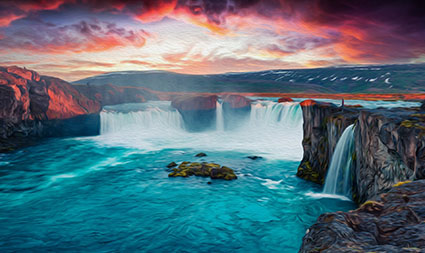
Vanaheimr “ the home of the Vanir”
In Norse mythology, Vanaheimr is one of the Nine Worlds and home of the Vanir, a group of gods associated with fertility, wisdom, and the ability to see the future. Vanaheimr is attested in the Poetic Edda; compiled in the 13th century from earlier traditional sources, and the Prose Edda and (in euhemerized form) Heimskringla; both written in the 13th century by Snorri Sturluson. In the Poetic Edda and the Prose Edda, Vanaheimr is described as the location where the Van god Njörðr was raised. In Norse cosmology, Vanaheimr is considered one of the Nine Worlds.
The surviving sources for our information on Norse mythology and religion, as fragmentary as they are, don’t contain any explicit mention of where exactly Vanaheim is located. The sole clue we have comes from the Lokasenna (“The Taunting of Loki“), one of the poems in the Poetic Edda, which states that the Vanir god Njord went eastward when he went to Asgard as a hostage at the conclusion of the Aesir-Vanir War. Presumably, then, Vanaheim lies somewhere to the west of Asgard. Some scholars have gone so far as to claim that Vanaheim was invented by the thirteenth-century Icelandic Christian historian and poet Snorri Sturluson. However, there is one authentic and reliable Old Norse poem that mentions Vanaheim by name, so we can be reasonably certain that it was a genuine element of pre-Christian Norse religion. It should come as no surprise, then, that the sources are completely silent as to what kind of world Vanaheim is. However, its name may contain an indication of the place’s character. One of the primary ways the pre-Christian Norse and other Germanic peoples classified geographical spaces (as well as psychological states) was with reference to their concept of the distinction between the innangard and utangard. That which is innangard (“inside the fence”) is orderly, law-abiding, and civilized, while that which is utangard (“beyond the fence”) is chaotic, anarchic, and wild. This psychogeography found its natural expression in agrarian land-use patterns, where the fence (the -gard or, in Old Norse, -garðr of the above terms) separated pastures and fields of crops from the wilderness beyond them. Of the Nine Worlds, two are innangard spaces: Asgard and Midgard, the world of human civilization. Both of these contain -gard in their names and are depicted as having a fence or fortification surrounding them. The rest of the Nine Worlds’ names end in -heim, and there’s no reference to their being enclosed in any way, which seems to indicate that they’re essentially utangard places. Such a designation is certainly in keeping with the way these places are described in Old Norse literature. Thus, we can infer that Vanaheim, like the Vanir themselves, is somewhat more wild or “natural,” and less “cultural,” than the world of the Vanir’s Aesir counterparts, or even that of humanity.