/ˈloʊki/
ᛚᛟᚲᛁ
The Trickster
Contents
- 1. Loki The God of many misconceptions
- 2. Loki's Bloodlines
- 3. Veneration
- 4. Loki s many tales
- 5. Loki's Punishment
- 6. Famous tales
- 6.1 The Forging of Mjolnir
- 6.2 The Fortification of Asgard
- 6.3 The Kidnapping of Idun
- 6.4 The Death of Baldur
- 6.5 The Tale of Utgarda-Loki
- 6.6 The Binding of Loki
- 7. Credits
The god of many descriptions and misconceptions
Loki is in some sources the son of Fárbauti and Laufey, and the brother of Helblindi and Býleistr. By the jötunn Angrboða, Loki is the father of Hel, the wolf Fenrir, and the world serpent Jörmungandr. By his wife Sigyn, Loki is the father of Narfi and/or Nari.
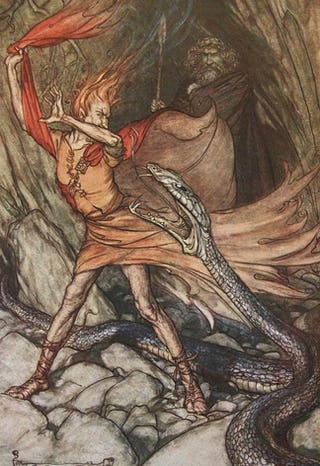
Loki is very handsome. He is plausible, convincing, likable, and far and away the most wily, subtle, and shrewd of all the inhabitants of Asgard. It is a pity, then, that there is so much darkness inside him: so much anger, so much envy, so much lust. Loki is the son of Laufey, who was also known as Nal, or needle, because she was slim and beautiful and sharp. His father was said to be Farbauti, a giant; his name means “he who strikes dangerous blows,” and Farbauti was as dangerous as his name. Loki walks in the sky with shoes that fly, and he can transform his shape so he looks like other people, or change into animal form, but his real weapon is his mind. He is more cunning, subtler, trickier than any god or giant. Not even Odin is as cunning as Loki. Loki is Odin’s blood brother. The other gods do not know when Loki came to Asgard, or how. He is Thor’s friend and Thor’s betrayer. He is tolerated by the gods, perhaps because his stratagems and plans save them as often as they get them into trouble. Loki makes the world more interesting but less safe. He is the father of monsters, the author of woes, the sly god. Loki drinks too much, and he cannot guard his words or his thoughts or his deeds when he drinks. Loki and his children will be there for Ragnarok, the end of everything, and it will not be on the side of the gods of Asgard that they will fight.
god of fire
The name “Loki” has long been likened to the Old Norse logi, meaning “fire.” While Loki, like fire, was destructive and unpredictable, the similarity between the two words was probably incidental. A newer and more likely etymology traced the name “Loki” to the Germanic words for “knot, loop, or tangle.” Such words have a literal connection to the deity—Loki was often depicted as a maker of fish —but also a deeper, metaphorical connection: Loki’s schemes were like webs that ensnared the unwary. Spiders were referred to as loki from time to time, as their webs caught unsuspecting victims in a similar manner. Loki was also likely referred to as a “knot” for his tendency to go against the other gods.
A worthy addition
Though Loki’s entrance into Norse mythology came later than most, his origins remained difficult to discern. In the oldest poetic works, such as the Grímnismál (which had fragments going back to the eighth century), Loki was conspicuously absent. In non-Norse sources of pre-Christian Germanic religion, Loki was once again either absent or presented in a very different manner. Such evidence suggested that Loki was a deity unique to the Northern European, or Scandinavian, people.
Loki , the incorrigible
Loki’s great mischief always stood front and center in the trickster god’s rich mythological tradition. One classic story began with an act of wanton mischief and ended with the gods receiving a bountiful haul of treasures. The story appeared in Snorri Sturluson’s Skáldskaparmál of the Prose Edda. One day, Loki was feeling mischievous and decided to cut off all of Sif’s hair. Sif was Thor’s wife, and was known for her beautiful, flowing locks of blonde hair. Naturally, when Thor discovered Loki’s prank, he flew into a rage and threatened Loki with violence. Desperate to quell Thor’s anger, Loki promised to find the Black Elves and have them make a replacement.
Complex Family Ties
While treated as a nominal member of the gods, Loki occupies a highly ambivalent and ultimately unique position among the gods, giants, and the other kinds of spiritual beings that populate the pre-Christian Norse religion.
His familial relations attest to this. His father is the giant Farbauti (Old Norse Fárbauti, “Cruel Striker”). His mother is Laufey (the meaning of which is unknown) or Nal (Nál, “Needle”). Laufey/Nal could be a goddess, a giantess, or something else entirely – the surviving sources are silent on this point. Loki is the father, by the giantess Farbauti (Angrboða, “Anguish-Boding”), of Hel , the goddess of the underworld (Helheim); Jormungand, the great serpent who slays Thor during Ragnarok; and Fenrir, the wolf who bites off one of the hands of Tyr and who kills Odin during Ragnarok – hardly a reputable brood, to say the least. As we’ll see below, Loki demonstrates a complete lack of concern for the well-being of his fellow gods, a trait which could be discerned, in vague outline, merely by considering these offspring of his.

Veneration
Even though Loki is in some sense a god, no traces of any kind of worship of Loki have survived in the historical record.[1] Is this any wonder, given that his character is virtually the antithesis of traditional Norse values of honor, loyalty, and the like – and that he is ultimately a traitor to the divinities the Norse held in such reverence?
Loki's Rune
The rune that corresponds to Loki is the sixth rune, Kaunaz (also romanised as Kennaz, Kenaz), the rune of illumination, knowledge, and kinship. Kaunaz had both positive and negative implications, much like Loki’s propensity for both mischief and aid.
Kaunaz is translated as torch, and is also associated with the hearth, as was Loki in his earlier role in mythology. It was indicative of sudden intuition and understanding, insight, cunning, and creative thinking – Loki’s most prominent qualities. It also represented many aspects of Loki’s personality: enthusiasm, opportunism, mischievousness, transformation, arrogance, and passion. On a more physical level, it would indicate improved health, but could also symbolise burning pain, fever, or ulcers.
Loki's many tales
In the tales, Loki is portrayed as a scheming coward who cares only for shallow pleasures and self-preservation. He’s by turns playful, malicious, and helpful, but he’s always irreverent and nihilistic.
The Kidnapping of Idun
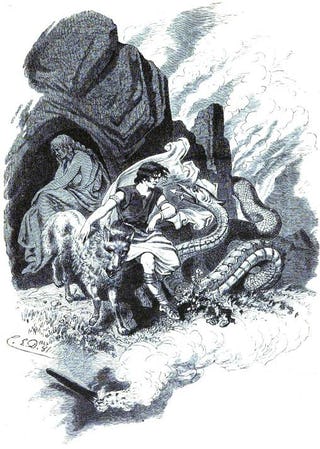
Loki, by his recklessness, ends up in the hands of a furious giant, Thiazi, who threatens to kill Loki unless he brings him the goddess Idun. Loki complies in order to save his life, and then finds himself in the awkward position of having the gods threaten him with death unless he rescues Idun. He agrees to this request for the same base motive, shifting his shape into that of a falcon and carrying the goddess back to Asgard in his talons. Thiazi pursues him desperately in the form of an eagle, but, having almost caught up with Loki as he nears his destination, the gods light a fire around the perimeter of their fortress. The flames catch Thiazi and burn him to death, while Idun and Loki reach the halls of the gods safely. Loki ultimately comes to the aid of the gods, but only to rectify a calamity for which he himself is responsible. This theme is repeated in numerous tales, such as in The Creation of Thor’s Hammer and the aforementioned The Fortification of Asgard.
After Thiazi’s death, the giant’s daughter, Skadi, arrives in Asgard demanding restitution for the slaying of her father. One of her demands is that the gods make her laugh, something which only Loki is able to do. To accomplish this, he ties one end of a rope to the beard of a goat and the other end to his testicles. Both he and the goat squawk and squeal as one pulls one way and the other pulls the other way. Eventually he falls over in Skadi’s lap, and the giantess can’t help but laugh at such an absurd spectacle. Here, Loki once again comes to the aid of the gods, but simply by being silly and outlandish, not by accomplishing any feat that a Viking Age Scandinavian would have found to be particularly honorable.
Loki alternately helps both the gods and the giants, depending on which course of action is most pleasurable and advantageous to him at the time. During Ragnarok, when the gods and giants engage in their ultimate struggle and the cosmos is destroyed, Loki joins the battle on the side of the giants. According to one Old Norse poem, he even captains the ship Naglfar, “Nail Ship,” which brings many of the giants to their battle with the gods.[5] When the battle for the world is fought, he and the god Heimdall mortally wound each other.
The Death of Baldur
Loki is perhaps best known for his malevolent role in The Death of Baldur. After the death of the beloved god Baldur is prophesied, Baldur’s mother, Frigg, secures a promise from every living thing to not harm her son. Well, almost everything – no such oath is obtained from the mistletoe, which the gods think too small and safe a thing to harm Baldur. Upon discovering this omission, Loki carves a mistletoe spear, places it in the hands of the blind god Hod, and instructs him to throw it at Baldur. Hod, not knowing the origin of the weapon, complies, and Baldur is impaled and dies. The god Hermod rides Sleipnir to the underworld and implores Hel to release Baldur, pointing out how beloved he is by all living things. Hel retorts that if this is so, then it shouldn’t be difficult to compel every being in the world to weep for Baldur, and, should this happen, the dead god would be released from the grave. Every living thing does indeed cry for Baldur’s return, with one sole exception: a frost-hearted giantess named Tokk (Þökk, “Thanks”), who is almost certainly Loki in disguise. So Baldur must remain with Hel.

Loki's Punishment
in the myth, there were many times that the Gods made Loki make amends for his pranks. However, Loki received his heaviest punishment right before the Ragnarok.
For his many crimes against them, the gods eventually forge a chain from the entrails of Loki’s son Narfi (Sons of Loki, Vali and Nari, were brought there. Vali, in the form of a wolf, killed his brother Nari.) and tie him down to three rocks inside a cave. A venomous serpent sits above him, dripping poison onto him. Loki’s apparently very faithful and loving wife, Sigyn, sits at his side with a bowl to catch the venom. But when the bowl becomes full, of course, she has to leave her husband’s side to pour it out. When this happens, the drops of venom that fall onto him cause him to writhe in agony, and these convulsions create earthquakes. And in this state he lies until breaking free at Ragnarok.
Loki was punished many times by Norse gods. He got punished by Thor when he deliberately cut the hair of Sif – Thor’s wife. Freya also punished him for stealing her necklace. The Norse gods decided to kill Loki unless he cleaned the mess he made with the giant builder of Asgard wall. He got away with the punishment easily with his intelligence. But not this time!
The Capture of Loki
Loki did not stay still to be bound and got a fatal blow by the Gods. He quickly knew how serious the situation was and escaped. He found a mountain in the middle of nowhere to build himself a house. His new house had four doors so that he could observe who was coming close. Every day he shapeshifted himself into a salmon and hid in the water Franangursfors. When the nights fell in, he turned back to Loki’s appearance. Odin on his high throne could see the place where Loki was hiding. He instantly assembled to Gods and set off capturing the murderer.
Loki was weaving his own net in his house when he realized the Gods were coming for him. Without hesitation, he threw the net into the fire and shapeshifted into the salmon. With the second-to-none intelligence of Kvasir, the Gods quickly knew where Loki was hiding. They wove the net and started to catch Loki. But Loki was just too smart to be caught easily. Every time the Gods spread the net, Loki got rid of it. Not until Loki made a bold leap to make it to the sea did Thor catch him by his tail.
A fascinating variant of the tale of Loki’s being bound comes to us from the medieval Danish historian Saxo Grammaticus. In his History of the Danes, Thor, on one of his many journeys to Jotunheim, the homeland of the giants, finds a giant named Útgarðaloki (“Loki of the Utgard“). Útgarðaloki is bound in exactly the same manner as that in which Loki is bound in the tale mentioned above, which comes from Icelandic sources.[2][3] It seems that even the pagan Scandinavians themselves held conflicting views on whether Loki was a god, a giant, or something else entirely
Consequences and Revenge
Undeniably, Loki deserved the punishment. No matter how useful he pretended to be to the Gods, he could not make up for what he had destroyed. The Death of Baldur was, for sure, the last straw that ignited the wrath of the Gods, not to mention Loki refusing to retrieve Baldur back from Hel. Prior to Baldur Death, there was a succession of troubles that Loki caused. Regarding the reasons why Loki wanted to take revenge on the Gods, there presumably are some reasons. First, the Gods had cast Loki's children, namely Fenrir, Jormungandr, and Hel, to the middle-of-nowhere place when they were little. Second, the deeds of using Loki's son entrails to bind him were somewhat unacceptable.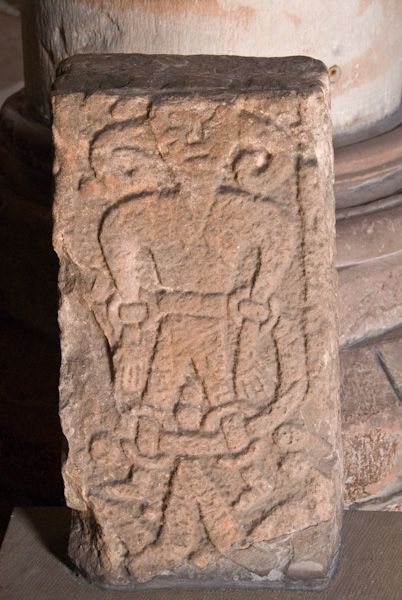
Famous tales
The Forging of Mjolnir
Loki stirs up mischief among the dwarves and almost loses his head, but ultimately gives the gods several priceless gifts, including Thor’s mighty hammer.
The Fortification of Asgard
A giant agrees to build a much-needed wall around the gods’ celestial stronghold, but his price is terrible. Loki saves the gods through a scandalously lewd act.
The Kidnapping of Idun
As a result of further mischief from Loki, the gods almost lose one of their most beloved companions.
The Tale of Utgarda-Loki
Thor and Loki travel to the land of the giants and engage their hosts in a series of contests.
The Death of Baldur
Baldur, one of the most cherished gods, dies an improbable death through the wickedness of Loki.
The Binding of Loki
Loki is punished in a particularly agonizing way for his murder of Baldur.
Credits
Please let us know if u have not been credited. We are gratefull to all people bringing this wonderful subject back to us.
References:
The writings of Dr. Jackson Crawford and Daniel Mc Coy are a neverending inspiration and most favoured of sources. the blog of Dr. Karl E. H. SeigfriedNorse-mythology.org
English editions: Saxo Grammaticus, The History of the Danes, Books I–IX, ed. and trans. Hilda Ellis Davidson and Peter Fisher. Latin text and English translation: Saxo Grammaticus, Gesta Danorum: The History of the Danes, ed. Karsten Friis-Jensen, trans. Peter Fisher. Cf. also Georges Dumézil, From Myth to Fiction: The Saga of Hadingus, trans. Derek Coltman.
References: [1] Sturluson, “Gylfaginning,” 55. ↩ [2] Saxo Grammaticus. 1905. The History of the Danes. Book VIII. [3] Turville-Petre, E.O.G. 1964. Myth and Religion of the North: The Religion of Ancient Scandinavia. p. 138.